Exploring Pythagorean Triples: Lengths of Hypotenuses and Practical Examples
This guide delves into Pythagorean triples, specifically using examples like (5, 12, 13) and (6, 8, 10) to demonstrate calculating hypotenuses. We discuss two methods: utilizing known Pythagorean triples and applying the Pythagorean Theorem. Through guided practice, students will learn to find unknown side lengths of right triangles and verify their calculations using both approaches. Clear step-by-step solutions are provided to enhance understanding of this fundamental concept in geometry.

Exploring Pythagorean Triples: Lengths of Hypotenuses and Practical Examples
E N D
Presentation Transcript
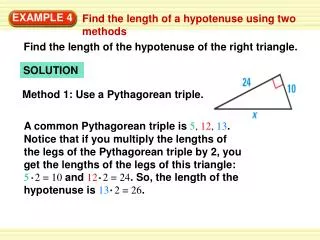
A common Pythagorean triple is 5, 12, 13. Notice that if you multiply the lengths of the legs of the Pythagorean triple by 2, you get the lengths of the legs of this triangle: 52 = 10 and 122 = 24. So, the length of the hypotenuse is 132 = 26. EXAMPLE 4 Find the length of a hypotenuse using two methods Find the length of the hypotenuse of the right triangle. SOLUTION Method 1: Use a Pythagorean triple.
EXAMPLE 4 Find the length of a hypotenuse using two methods Find the length of the hypotenuse of the right triangle. SOLUTION Method 2: Use a Pythagorean triple. x2 = 102 + 242 Pythagorean Theorem x2 = 100 + 576 Multiply. x2 = 676 Add. x = 26 Find the positive square root.
for Example 4 GUIDED PRACTICE 7. Find the unknown side length of the right triangle using the Pythagorean Theorem. Then use a Pythagorean triple. SOLUTION x2 = 122 + 92 Pythagorean Theorem x2 = 144 + 81 Multiply. x2 = 225 Add. x = 15 Find the positive square root.
Pythagorean triple. A common Pythagorean triple is 6, 8, 10. Notice that if you multiply the lengths of the legs of the Pythagorean triple by 3/2, you get the lengths of the legs of the triangle: 63/2 = 9 and 83/2 = 12. So, the length of the hypotenuse is 103/2 = 15. for Example 4 GUIDED PRACTICE
for Example 4 GUIDED PRACTICE 8. Find the unknown side length of the right triangle using the Pythagorean Theorem. Then use a Pythagorean triple. SOLUTION x2 = 482 + 142 Pythagorean Theorem x2 = 2304 + 196 Multiply. x2 = 2500 Add. x = 50 Find the positive square root.
Pythagorean triple. A common Pythagorean triple is 7, 24, 25. Notice that if you multiply the lengths of the legs of the Pythagorean triple by 2, you get the lengths of the legs of the triangle: 7 2 = 14 and 242 = 48. So, the length of the hypotenuse is 252 = 50. for Example 4 GUIDED PRACTICE