Download
1 / 2
20 likes | 123 Vues
This scientific update focuses on improving the understanding of ice shelf dynamics and basal hydrology through the integration of gravity and bathymetric data. By utilizing ideal grid surveys (5-10 km) and analyzing flow profiles, we can more accurately estimate basal conditions, including soft and hard beds. The research highlights the significance of regional geologic constraints and sediment fill sensitivity, especially in locations like Thwaites Glacier and Jakobshavn. Such insights are crucial for predicting the impacts of climate change on ice shelf stability and global sea levels.

E N D
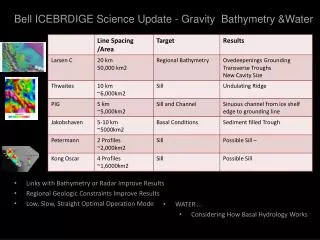
Bell ICEBRDIGE Science Update - Gravity Bathymetry &Water • Links with Bathymetry or Radar Improve Results • Regional Geologic Constraints Improve Results • Low, Slow, Straight Optimal Operation Mode • WATER…. • Considering How Basal Hydrology Works
Bell ICEBRDIGE Science Update - Gravity Bathymetry & Water • Morphology Beneath Ice Shelves – (Cochran and Bell) • Larsen C • Approach Grid Survey (5-10 km ideal), Inversion of grid • Constraining Sills • Thwaites (Tinto et al), PIG (Studinger et al), Petermann (Tinto et al) • Along Flow Profiles (5-10 km ideal), Analysis along profile • Estimating Basal Conditions – soft/hard bed • Jakobshaven (Block and Bell) • Flow Perpendicular Profiles, Requires good bed topography &coincident surface elevation • Fjord Geometry • Jakobshaven (Block and Bell) • Sensitive to Sediment Fill – Requires Bathymetry or Grounded Ice Thickness • NW Greenland (Tinto et al -) • Fjord Perpendicular Profiles) • Links with Bathymetry or Radar Improve Results • Regional Geologic Constraints Improve Results • Low, Slow, Straight Optimal Operation Mode • WATER…. • Considering How Basal Hydrology Works