Understanding Light: Properties, Spectrum, and the Expanding Universe
Light, a form of electromagnetic radiation, travels in waves and doesn't need a medium to propagate. It encompasses various types, including visible light, ultraviolet, infrared, and X-rays, each defined by its wavelength. Through tools like spectroscopes, astronomers can analyze light from stars to determine their composition, temperature, and movement. The Doppler Effect illustrates how light waves shift in wavelength due to motion, revealing phenomena such as redshift in distant galaxies, providing evidence for the expanding universe and supporting the Big Bang Theory.

Understanding Light: Properties, Spectrum, and the Expanding Universe
E N D
Presentation Transcript
What is light? • Light is a form of electromagnetic radiation that travels in waves. • Most forms of EM radiation are invisible. • Light waves do not need a medium like water or air to travel through. Empty space is fine.
Electromagnetic Radiation • Every object in the universe emits some kind of radiation. • The wavelength of light determines the characteristics of each form of radiation.
If you listen to music on the radio = radio wave radiation. • If you use a microwave = microwave radiation 3. Military & police may use infrared goggles to see body heat in the dark = infrared radiation
4. Visible light lets us see color. 5. An example of Ultra-violet radiation is a sunburn. 6. If you have an x-ray taken = x-ray radiation. 7. Radioactive materials emit Gamma ray radiation.
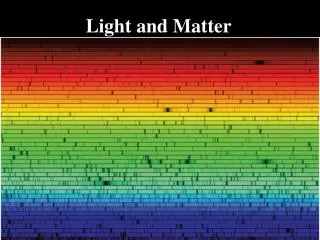
Visible Light and the Prism • Visible white light is made up of various colors as seen in a rainbow. • When sunlight passes through a prism, the waves are refracted (bent) and a rainbow called a spectrum is produced.
Spectroscope • A tool astronomers use to separate starlight into a spectrum. • A prism is inserted into a telescope to split the light into its colors.
The spectroscope can tell astronomers... • What a star is composed of • How hot a star is • How fast a star or galaxy is moving • The direction a star or galaxy is moving
Continuous • An unbroken band of colors • The source emits light of all visible wavelengths
Unevenly spaced lines of different colors. The source emits light of certain wavelengths. (l) Every element has a unique emission spectrum. Emission
Absorption • A continuous spectrum crossed by dark lines. • Determines elements in cool gases.
Argon Helium Mercury Sodium Neon Each element has a unique spectrum. • By observing the spectra of distant stars we learned what elements make up the atmosphere of stars (and planets).
Sound • Think about the sound a train makes as it approaches you compared to when it moves away from you.
There is a change in the pitch of the sound. • High pitch sounds have a short wavelength • Low pitch sounds have a long wavelength.
What is the Doppler Effect? • The shift in the wavelength produced by a moving source. • The change in pitch as something approaches you and moves away from you.
Light • Light with a long wavelength will appear red. • Light with a short wavelength will appear blue.
Approaching light = blue • Leaving light = red
Red Shift Sun Galaxy • A star or galaxy moving away from the Earth will produce a shift in its spectrum towards the red end.
Edwin Hubble observed most galaxies in the universe show a red shift.
The Big Bang Theory • Red shifts are evidence supporting the Big Bang. • It’s the dominant scientific theory about the origin of the universe • The universe was created sometime ~ 10-20 billion years ago from a cosmic explosion that hurled matter in all directions.