Understanding Exponential Functions and Euler's Number
130 likes | 277 Vues
This lesson focuses on exponential functions and the concept of Euler's number (e), defined as approximately 2.718. We'll explore growth and decay represented in exponential equations, utilizing e as a constant. The session covers simplification of expressions involving e, and we'll graph key functions to identify their domain, range, and asymptotes. Additionally, don't forget to check resources available on mrwaddell.net and complete the assignment from Chapter 7.3, focusing on functions and their properties.


Understanding Exponential Functions and Euler's Number
E N D
Presentation Transcript
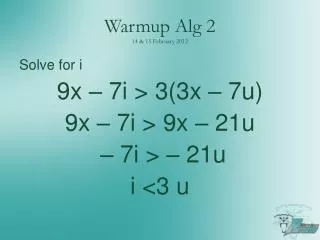
WarmupAlg 214 & 15 February 2012 • Solve for i • 9x – 7i > 3(3x – 7u) • 9x – 7i > 9x – 21u • – 7i > – 21u • i <3 u
Agenda • Don't forget about resources on mrwaddell.net • Sec 7.3 : Functions w/ e • Euler’s number • A=Pert • Growth and Decay revisited
Exponential equation “b” can be any positive number If “b” is bigger than 1 then it is GROWTH (y gets bigger) If “b” is between 0 and 1 then it is DECAY (y gets smaller) If the exponent has a “-” sign, then it is also decay!
A new “Transcendental” Constant • You know about . • is a constant used in geometry, 3.14159… • e is another constant similar in nature to . • e is equal to 2.718281828459045… and is called the “Natural Number” • (but 2.718 is good enough)
Exponential equation If we use e as our constant instead of “b”. If “r” is positive, it is growth If “r” is negative it is decay
Page 493 2.718 is e
Domain and Range • State the domain and range and asymptote • of the equation: D: All real numbers R: y > 2 and A: y = 2 1. y=2e3x + 2 D: All real numbers R: y > -4 and A: y = -4 2. y= ½ e-2x -4 D: All real numbers R: y > -2 and A: y = -2 3. y= .8e4(x+3) -2
Simplifying expressions with e • Simplify the expression: 1. e7 1. e2∙e5 2. 1/e2 2. e2∙e-4 3. 27e6 3. (3e2)3 4. 2e3 4. (8e9)1/3
Graphing: domain and range What is the domain? x is all real numbers What is the range? y > 1 What is the asymptote? y = 1 f(x) = 2(e)x-2 +1
Graphing: domain and range What is the domain? x is all real numbers What is the range? y > 4 What is the asymptote? y = 4 f(x) = 3(e)-x+1 +4
Assignment • Chapter 7.3: • 5 – 13, • 31 – 38, • 47 – 49