
Geography's Impact on Indian People: Land, Rivers, Monsoon & Religion
E N D
Presentation Transcript
India Geography’s affect on the Indian people The Indian subcontinent The physical regions of India The Ganges, Brahmaputra, and Indus rivers The Indian Monsoon
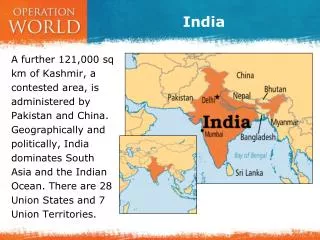
The Indian Subcontinent • India is apart of a larger piece of land called the Indian “Subcontinent” • A landmass that is part of a continent but is geographically an independent entity • India is separated from Asia by the Himalaya and Hindu Kush Mountains • The Indian subcontinent is divided into three major physical regions • The Northern Mountains • The Indo- Gangetic Plain • The Deccan Plateau
The Northern Mountains • Himalayan Mountains • Tallest mountain range in the world • 20 mountains that are over 24,000 ft. high • Mount Everest • Tallest peak at 29,035 ft • First climbed by Edmond Hilary & Tenzing Norgay in 1953 • Many have tried to climb it since and hundreds have died • Creates the majority of the northern border of India • Source of important rivers to India • Ganges, Feni, Indus, and Brahmaputra rivers
The Northern Mountains • Hindu Kush • Named for their danger • Kush= Death • Extremely rugged • Like the Himalayas are a source of water for much needed rivers
Indo- Gangetic plain • Area that surrounds the Ganges and Brahmaputra rivers • Best farmland in India • No coincidence that this is one of the two most densely populated areas in India • They farm rice, wheat, cotton, sugarcane, and tea
Ganges River • Begins in the Himalayas and flows 1500 miles directly through the Indo- Gangetic plain • Also known as “Gangamai” or Mother Ganges • Important for farming, trade, and transportation • Holiest river of Hinduism • Home to the Goddess Ganga • Hindus believe they must purify themselves in it • Travel down the sacred “Ghats” or steps • Bathe and drink water to wash away their sins • Ashes of the dead are scattered in the water
Ganges River • One of the most polluted rivers on earth • Raw sewage, industrial waste, dead animals and humans have poisoned the water • Toxic chemicals and bacteria • Dangerous to Hindus who bath in and drink it • Hepatitis, typhoid, and cholera are common • Many Hindus travel as far upstream as they can before purifying themselves • Cities like Varanasi get many bathers because of the relatively clean water • Less pollution
Indus River • Begins in the Himalayas and flows 1975 miles through the country of Pakistan • Formerly apart of India • Important to the development of the first cities and civilizations in India • Mohenjo- Daro and Harrapan civilizations • Important for farming, trade, and transportation • Today it the at the front lines of conflict between India and Pakistan • Fighting over the fertile cotton fields of Kashmir
Brahmaputra River • Begins in the Himalayas and flows 1100 miles through northern Indian the country of Bangladesh • Important for farming, trade, and transportation • Important to Hinduism like the Ganges • Represents one of the main gods of Hinduism called Vishnu • The river is credited with preserving all life along its banks
The Monsoon • India has two major seasons • Summer is hot and very wet • Winter is cool and very dry (still hot) • The climate is caused by the “Monsoon” • Seasonal winds • During summer the winds come from the Indian Ocean & bring large amounts of rain • During winter the winds come from the land and are dry
The Monsoon • Summer monsoon is essential for survival • Brings needed water for farming • But the heavy rains also cause great devastation • Flooding and “cyclones” are common • Violent storms like hurricanes • Eastern India and Bangladesh suffers great damage almost every year • Villages and farms are flooded and destroyed • Overflowing of rivers • Ganges and Brahmaputra
Religious Life • Majority of people practice Hinduism. • They believe that everything has a spirit or soul which comes of the creator Brahma. • Because everything has a soul animals (esp. Cows) are greatly respected. • Cows are sacred! MOOO!!! • Final goal of Hinduism is to have unity with Brahma- a state of bliss without change or pain • Soul must pass through cycles of reincarnation until soul becomes pure.
Caste System (Social Hierarchy) • People are Born into their rank in society. • Each caste has its own duties and obligations. • Hindus believe that they can improve their station in the next life if their carry out their duties well in their current life. • Social relationships are often confined to their own social class. • Untouchables have few educational and employment opportunities the other classes.
Other Religions • Other religions in India: • Islam • Christianity • Sikhism • Jainism • Sikhism began as a movement to combine Hinduism and Islam • Sikhs are not divided into castes • Jainism (reaction to Hinduism) teaches non-violent and avoids harming any living creature.