franz
Uploaded by
144 SLIDES
1584 VUES
1440LIKES

Understanding Water, Carbon Compounds, and Their Bonding Properties in Nature

DESCRIPTION

Explore the fascinating properties of water (H2O) and carbon-based compounds, focusing on their bonding characteristics and functional groups. Discover how covalent bonds form between hydrogen and oxygen, creating the unique properties of water, including its polar nature and hydrogen bonding. Learn about organic compounds, the structure of carbohydrates like glucose, and the roles of functional groups such as hydroxyl and carboxyl. Examine how these compounds form polymers and macromolecules, highlighting the significance of monomers and the process of condensation synthesis in biological systems.

1 / 144

Télécharger la présentation

Understanding Water, Carbon Compounds, and Their Bonding Properties in Nature

An Image/Link below is provided (as is) to download presentation Download Policy: Content on the Website is provided to you AS IS for your information and personal use and may not be sold / licensed / shared on other websites without getting consent from its author. Content is provided to you AS IS for your information and personal use only. Download presentation by click this link. While downloading, if for some reason you are not able to download a presentation, the publisher may have deleted the file from their server. During download, if you can't get a presentation, the file might be deleted by the publisher.

E N D

Presentation Transcript


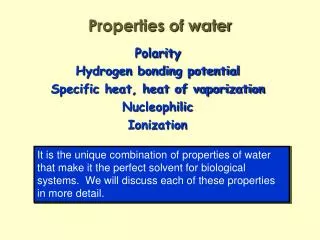
  1. Water Properties

  2. Carbon Compounds

  3. Functional Groups

  4. Bonding of Carbon

  5. Water & Nature

  6. Polymers

  7. Carboncompounds Water inNature H2O Properties FunctionalGroups Bonding of Carbon Polymers $100 $100 $100 $100 $100 $100 $200 $200 $200 $200 $200 $200 $300 $300 $300 $300 $300 $300 $400 $400 $400 $400 $400 $400 $500 $500 $500 $500 $500 $500

  8. Type of bond between hydrogens & oxygen

  9. What is covalent?

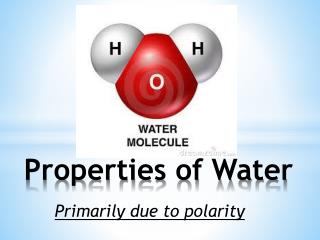
  10. Polar charge on each end of a water molecule

  11. What is positive hydrogen & negative oxygen?

  12. Overall charge on a water molecule

  13. What is zero or no charge?

  14. Bonding that causes water to cling to itself

  15. What is hydrogen bonding or cohesion?

  16. Attraction of water that produces surface tension

  17. What is cohesion?

  18. Compounds with covalently bonded carbon atoms

  19. What is an organic compound?

  20. Number of covalent bonds carbon can form

  21. What is four?

  22. Number of electrons shared in a triple bond

  23. What is six?

  24. Glucose in cells has this carbon shape

  25. What is a ring structure?

  26. Carbon shape resulting from the attachment of side groups to a chain

  27. What is a branched chain?

  28. Effect these groups have on organic compounds

  29. What is change the properties?

  30. OH- group gives this property to organic compounds

  31. What is an alcohol or polar?

  32. -COOH group

  33. What is a carboxyl group?

  34. Daily Double!!

  35. -NH2 group is found on this type of macromolecule

  36. What are proteins?

  37. -PO4 group is found on this macromolecule

  38. What are nucleic acids?

  39. Small subunits bonded together to make large carbon compounds
  40. What are monomers?

  41. Simplest type of bond between two carbon atoms

  42. What is a single covalent bond?

  43. Repeating linked carbon units or monomers make this

  44. What is a polymer?

  45. Large polymers are called this

  46. What are macromolecules?

  47. Process that links monomers by removing molecules of water

  48. What is condensation or dehydration synthesis?

  49. Allows some insects to walk across the top of water

More Related
SlideServe
Audio
Live Player
Audio Wave
Play slide audio to activate visualizer