Covalent Compounds: Naming, Bonding, and Structures
Learn about covalent compounds, naming binary compounds, diatomics, binary acids, oxyacids, and covalent bond formations. Explore Lewis structures, single vs. multiple covalent bonds, and practice with various compounds.


Covalent Compounds: Naming, Bonding, and Structures
E N D
Presentation Transcript
Covalent Compounds January 2015
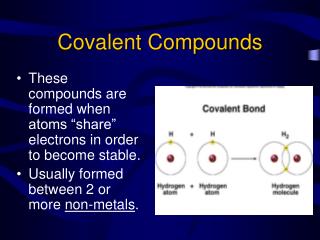
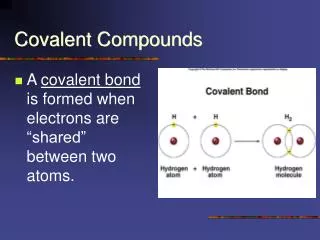
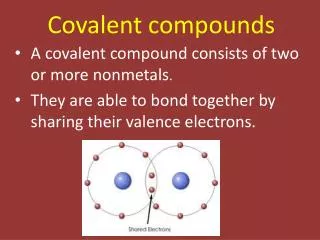
Covalent Compounds • Covalent Bond – chemical bond that results from sharing electrons • Molecule – formed when two or more atoms are bonded covalently
Naming Binary Compounds • First element named first • Second elements ending is changed to –ide • Use prefixes to indicate the number of each atom • Examples: • N2O – dinitrogen monoxide • CCl4 – carbon tetrachloride
Prefixes • Mono – • Di- • Tri- • Tetra- • Penta- • Hexa- • Hepta- • Octa- • Nona- • Deca-
Diatomics • There are seven elements that always exist as diatomics • Always exist bonded to themselves in nature • Example: H2 • H BrONClIF or BrINClHOF
Practice – Name or give the Formula • NF3 • P2O5 • F2 • OBr2 • BF3 • CH4 • NO • BN • Carbon disulfide • Selenium • Nitrogen trihydride • Sulfur dioxide • Phosphorous pentabromide • Xenon hexafluoride • Tetraarsenic decoxide • Trinitrogen nonoxide
Answers • Nitrogen trifluoride • Diphosphorus pentoxide • Fluorine • Oxygen dibromide • Boron trifluoride • Carbon tetrahydride • Nitrogen monoxide • Boron mononitride • CS2 • Se • NH3 (ammonia) • SO2 • PBr5 • XeF6 • As4O10 • N3O9
Naming Binary Acids • Contains Hydrogen and one other element • The first word has the prefixhydro- , the rest of the first word consists of the root of the second element plus the suffix–ic • The second word is always acid • Example • HCl : hydrochloric acid • H2S : hydrosulfuric acid
Practice • HBr • HI • H3P • Hydrofluoric acid • Hydroselenic acid • Hydrochloric acid • Hydrobromic acid • Hydroiodic acid • Hydrophosphoric acid • HF • H2Se • HCl
Naming Oxyacid's • Contains both a hydrogen and an oxyanion (polyatomic) • Keep the root of the oxyanion • Include prefixesper- and hypo- as part of the name • If the oxyanion ends in –atereplace with –ic • If the oxyanion ends in –itereplace with –ous • The second word is acid • Example • HNO3 : nitric acid • HClO : hypochlorous acid
Practice • H2SO4 • HClO4 • H3PO4 • Carbonic acid • Acetic acid • nitrous acid • Sulfuric acid • Perchloric acid • Phosphoric acid • H2CO3 • HC2H3O2 • HNO2
What is the formula for hydroxic acid? • H2O • HOH
Look at Fluorine • Fluorine has 7 valence electrons, it needs 1 more electron to form an octet • As two fluorine atoms approach one another attractive forces and repulsive forces act upon the two atoms • Once that atoms are close enough together they bond covalently to form a fluorine molecule.
Structures Electron Dot Structure Lewis Structure
Practice – Lewis Structures • PH3 • H2S • CCl4
Answers • or • or • or
Single Covalent Bonds • They are also called sigma bonds (σ) • Sigma bonds occur when the shared pair of electrons is centered between the two atoms
Multiple Covalent Bonds • Atoms can share more than one pair of electrons with another atom • Double or Triple bonds • Oxygen and Nitrogen • Multiple covalent bonds consist of one sigma and at least one pi bond (π) • Pi bonds form when parallel orbitals overlap and share electrons
How many Sigma and Pi bonds are there? C2H2 C2H4
More Lewis Structures • NF3 • CO2 • SiF4 • CH4 • OCl2 • NCl3