Download
1 / 20
200 likes | 333 Vues
Thermochemistry explores the energy changes associated with chemical reactions, focusing on the principles of heat transfer, work, and the conservation of energy. This field covers concepts such as kinetic and potential energy, the first law of thermodynamics, and enthalpy changes. By utilizing calorimetry and applying Hess's Law, we can determine the heat of reactions and standard enthalpy of formation. Understanding these principles helps in predicting reaction spontaneity and the behavior of substances under various conditions.

E N D
THERMOCHEMISTRY ENERGY CHANGES ASSOCIATED WITH CHEMICAL REACTION
ENERGY • Capacity to do work or supply heat • Kinetic Energy: EK = 1/2 mv2 = energy due to motion, Joule • Potential Energy: EP = stored energy due to position, energy in a chemical bond, Joule • Energy is conserved (Fig 8.1) • SI unit: Joule = kg (m/s)2; 1 calorie = 4.184 Joule
HEAT • Energy transfer between system (chem rxn of reactants and products) and surroundings (everything else) due to temperature difference, Joule • q > 0 if heat absorbed by chem rxn; endothermic • q < 0 if heat given off by chem rxn; exothermic
WORK • Energy transfer between system and surroundings, Joule • w = F · d = force that moves object a distance d • w = -P ΔV where P = external pressure • If w < 0, gas expands, system loses energy • If w > 0, gas is compressed, system gains energy
FIRST LAW OF THERMODYNAMICS • Total energy of an isolated system is constant; in a phys. or chem. change, energy is exchanged between system and surroundings, but not created nor destroyed. • ΔE = internal energy = q + w = Efinal - Einitial • If ΔV = 0, then ΔE = qV • ΔE < 0, energy lost by system • ΔE > 0, energy gained by system
STATE FUNCTIONPATH FUNCTION • State Function: A property of the system which depends only on the present state of the system and not the path used to get there; E, V, T • Path Function; a property that depends on path taken during the change; w and q. • Note ΔE = w + q is a constant for specific initial and final states even though q and w are path functions.
ENTHALPY • If the reaction occurs at constant pressure, heat associated with rxn = enthalpy, Joule • H = state function, tabulated in B1, B2 • H = E + PV; ΔH = ΔE + P ΔV = qP • ΔH = Hfinal - Hinitial = HP - HR • ΔH < 0 energy lost by system, exothermic • ΔH > 0 energy gained by system, endothermic
ENTHALPY (2) • Enthalpy depends on amount of substance (I.e. #mol, #g); extensive property. • Chemical rxns are accompanied by enthalpy changes that are measurable and unique.
THERMOCHEMICAL EQUATION • Balanced chemical equation at a specific T and P includes reactants, products, phases andΔH . • Basis for stoichiometric problems that focus on ΔH associated with the chemical rxn. • ΔH for reverse rxn =- ΔH for forward rxn • If amount of reactants or products changes, then ΔH changes
THERMODYNAMIC STANDARD STATE • We define the standard state of a substance as its most stable state at T = 25oC, P = 1 atm (or 1 bar) and concentration = 1 M. • ΔHo = standard enthalpy of rxn or heat of rxn when products and reactants are in their standard states.
PHYSICAL CHANGES • Melting/freezing solid / liquid • Boiling/condensing liquid / vapor • Subliming/condensing solid / vapor • The former changes are endothermic; the latter are exothermic. • Note that these changes are reversible.
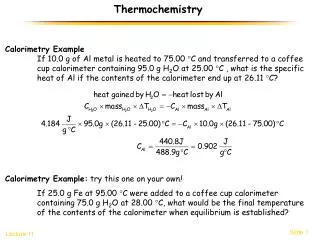
CALORIMETRY • Experimental method of determining heat (q) absorbed or released during a chem. rxn. at constant P (ΔH) or constant V (ΔE). • This heat is proportional to the temp. change during the rxn: q = C ΔT where C is a constant and ΔT = Tfinal - Tinitial. • C is the heat capacity of the calorimeter; J/oC
CALORIMETRY (2) • s = specific heat capacity = amount of energy needed to raise the temp. of 1 g of material 1 oC; (s has units of J/oC-g) T 8.1 • Cm = Molar Heat Capacity = amt of energy needed to raise temp. of 1 mol of sample 1 oC ( J/mol-oC) • q = s m ΔT or q = Cm n ΔT • If ΔP = 0, then ΔH = q; if ΔV = 0, then ΔE = q
HESS’S LAW: Law of Heat Summation • Given a specific chem rxn at a stated T and P values, ΔH for the chem rxn is • constant and not dependent on intermediate chem rxns. • the sum of the enthalpy changes for the intermediate rxns. (Chem eqns are additive and their associated rxn ΔH values are additive). • Hess’s Law facilitates the determination of rxn enthalpies for numerous rxns.
STANDARD HEAT OF FORMATION • Enthalpy change for the formation of one mole of a substance in its standard state from its elements in their standard states • ΔHof (1 atm and 25 oC) values are tabulated in App. B; note elements have ΔHof = 0. • Combine ΔHof to calculate heat of rxn. • ΔHorxn = ∑ΔHof (prod.) - ∑ ΔHof (react.)
BOND DISSOCIATION ENERGY • We can use bond dissociation energies to approximate heat of rxn (recall prob 7.110) • ΔHo = D(react bonds) – D(prod bonds) • D values in T7.1 • D values are positive (bond breaking requires energy and bond formation releases energy) and are given in kJ/mol
COMBUSTION • Type of reaction in which substance burns in oxygen.
ENTROPY • Achieving stability has been related to minimizing energy; e.g. molecular geometry. But there is another important property called entropy (S) that affects the direction of chem rxn. • Entropy is a measure of disorder. Processes proceed spontaneously in the direction that increases disorder.
ENTROPY (2) • Therefore, spontaneous processes are favored by a decrease in enthalpy (energy when pressure is constant) and an increase in entropy. • Mathematically, this means ΔH < 0 (exothermic) and ΔS > 0 favor R P • Units of J/oC-mol
FREE ENERGY • A new property, Gibbs Free Energy, combines the contributions of ΔH and ΔS. • ΔG = ΔH - T ΔS • ΔG determines direction of rxn • Units of kJ/mol