60 likes | 214 Vues
This lecture explores the significance of colors in astronomical observations, particularly how they relate to stellar temperatures and interstellar extinction. Colors, derived from flux measurements through various filters, provide insights into star characteristics. The lecture discusses the importance of standard filters (Johnson UBVRIJHK) and explains how stellar colors impact magnitude measurements, with examples like the color differences observed in stars such as Sirius and Antares. It also highlights the effects of interstellar dust, which alters light and affects color observations, particularly in infrared studies of the Galactic Center.
E N D
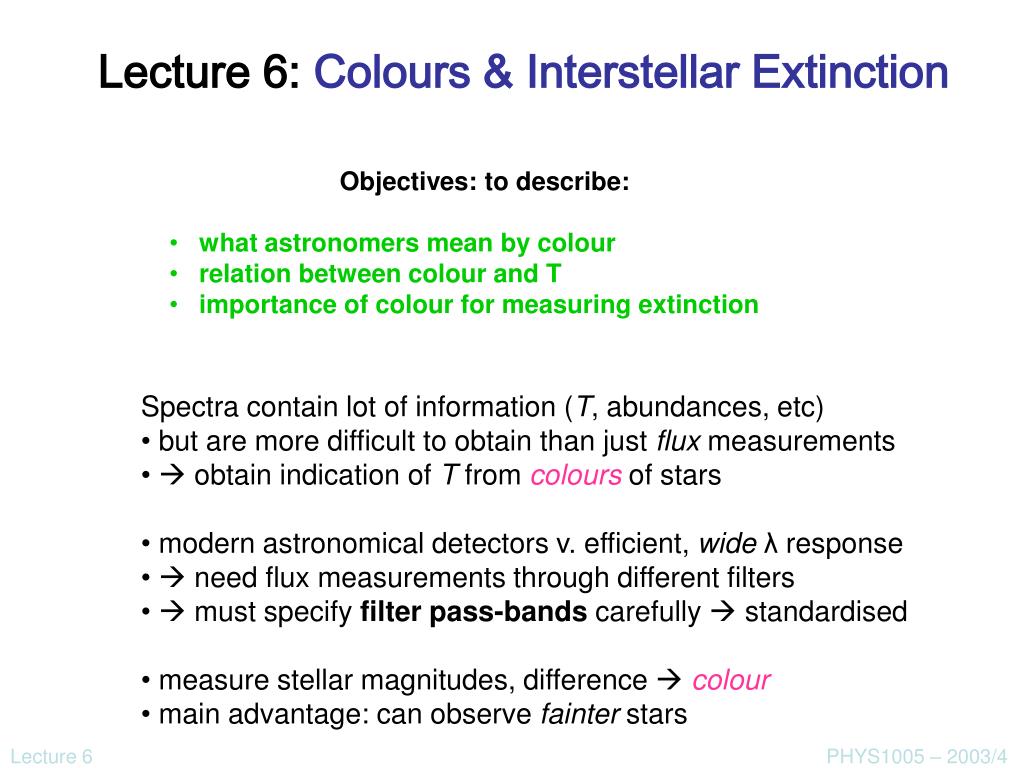
Lecture 6: Colours & Interstellar Extinction • Spectra contain lot of information (T, abundances, etc) • but are more difficult to obtain than just flux measurements • obtain indication of T from colours of stars • modern astronomical detectors v. efficient, wideλ response • need flux measurements through different filters • must specify filter pass-bands carefully standardised • measure stellar magnitudes, difference colour • main advantage: can observe fainter stars Objectives: to describe: what astronomers mean by colour relation between colour and T importance of colour for measuring extinction PHYS1005 – 2003/4

Examples of astronomical colour images: A2219 all are composite images formed from B&W images through different colour filters (e.g. B, I) M37 PHYS1005 – 2003/4
Standard Filters are Johnson UBVRIJHK: • must be standardised to allow comparison of observations • Johnson set standards in 50s and 60s • based on glass and detector properties; in wide use today • key parameters: • central λ and bandwidth (= width at half-max) • designated by λcene.g. U = ultra-violet, B = blue • JHK cover IR, not listed here PHYS1005 – 2003/4
Stellar Colours • m1 – m2 = -2.5 log10 (F1/F2) • magnitude measured through filter written: • mV, or usually V • e.g. Sirius has visual magnitude of V = -1.4 • now measure B, V of a star colour = B –V • N.B. this is ratio of fluxes through each filter • e.g. Antares has B – V = +1.8 it is 1.8 mags fainter (i.e. factor 5) through B compared to V • Vega is defined to have zero magnitude through all filters, hence B – V = 0 • colours are relative to Vega • hence colour T Shorter λwritten first e.g. B-V or V-R; but neverV - B N.B. positive colours RED PHYS1005 – 2003/4
Temperatures and Colour • U – R colour of B-B curve:- • clearly colour related to T: • as T → 0 , colour → ∞ • as T → ∞ , colour → constant Interstellar Extinction • important use of colour to measure interstellar extinction • due to gas and dust (~ smoke) which absorbs and scatters light • e.g. Coalsack Nebula (AAO image) PHYS1005 – 2003/4
Effect of Extinction: • extinction very patchy! • averages ≈ 1.9 mags/kpc in plane of Galaxy in V • > 30 mags towards Galactic Centre (what is the factor!) • effect stronger at short λ objects appear red, hence reddening (e.g. Sunset) • N.B. 10 mags of extinction in V (factor 104) ≡ only 1.1 mags in K (IR) • hence studies of Galactic Centre only performed in IR and beyond • absorption weakens again at hard X-ray and γ-ray wavelengths • can use reddening to estimate amount of interstellar extinction: • e.g. star has spectral type known to have B – V = +0.2, but is observed to have B – V = +3.0; what is visual extinction (in mags) to the star? • Answer: Essential to account for extinction and reddening! PHYS1005 – 2003/4