
Collaborative Analysis of Particle Detector Data for Future Research Goals
E N D
Presentation Transcript
Analysis tasks David Ward Nige Watson David Ward/Nige Watson TexPoint fonts used in EMF. Read the TexPoint manual before you delete this box.:
Aims for today • Review the reconstruction/analysis tools. • Identify what we need. • Identify gaps. • Attach names to topics. Discuss timescales. • List main analysis topics. • Start attaching names to topics (probably not quite so urgent) • Topics not all equal in size; some may involve several people and need internal coordination. David Ward/Nige Watson
Objectives • Valencia (November 2006) – basic plots to show detectors working, data taken etc. No quantitative results. • Vienna (February 2007) – mainly technical, but a good chance to show some progress • LCWS Hamburg (June 2007) – aim to show comprehensive analysis of CERN’06 test beam data – detector performance; validation of Monte Carlo. Electron analysis could be close to final? Hadron analysis will probably be less complete. David Ward/Nige Watson
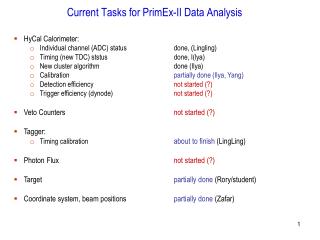
Tools: Beam Line reconstruction • Each of these items should consist of one or a few, Marlin processors. • Drift chamber calibration (drift velocity, position) [M.Faucci-Gianelli] • Track reconstruction and extrapolation using drift chambers. [M.Faucci-Gianelli] • Use of Cerenkov counters for particle ID [F.Salvatore, Beni Lutz, Manqui Ruan] David Ward/Nige Watson
Tools: ECAL hit reconstruction • By reconstruction, we mean conversion of raw data to calibrated LCIO calorimeter hits, suitable for comparison with Mokka. • Each of these items should consist of one, or a few, Marlin processors. • Calibration, using muon data [Götz Gaycken (→???)] • Pedestal subtraction, gain correction and zero suppression. [Götz Gaycken (→???)] • Data quality. Processors to flag/remove unreliable (e.g. noisy) data. [Manqui Ruan + …] • Digitization processor(s) to simulate random/correlated noise, crosstalk, dead cells etc. [Anne-Marie Magnan …] David Ward/Nige Watson
Tools: AHCAL hit reconstruction • Each of these items should consist of one, or a few, Marlin processors. • Calibration, using muon data [Niels Meyer] • SiPM nonlinearity correction [Niels Meyer] • AHCAL data quality. Processors to flag/remove unreliable (e.g. noisy) data. [Sebastian Schmidt] • Digitization processor(s) to simulate random/correlated noise, crosstalk, dead cells etc. David Ward/Nige Watson
Tools: TCMT reconstruction • Each of these items should consist of one, or a few, Marlin processors. • TCMT calibration using muons [Guilherme Lima] • SiPM nonlinearity correction [G.Lima] • TCMT data quality. Processors to flag/remove unreliable (e.g. noisy) data. • Digitization processor(s) to simulate random/correlated noise, crosstalk, dead cells etc. [G.Lima] David Ward/Nige Watson
Tools: Miscellaneous • Flagging + documenting good quality data runs for analysis. Recording problems. [Erika, Vasiliy] • Alignment between detectors [Valeria Bartsch]. • Identification of clean single electron samples using Cerenkov, shower properties etc. Dependent on beam conditions (CERN, DESY etc.) • Identification of clean pion (and other hadrons?) samples, and muons. • Reconstruction production [Roman Poeschl] • Run analysis (Marlin) jobs on the Grid. David Ward/Nige Watson
Analysis: ECAL specific topics • Energy response and resolution vs. energy for electrons.[DRW, V.Bartsch] • Energy response and resolution vs. angle for electrons. .[Valeria Bartsch, Laurent Morin] • Position and angular resolution for electrons. [Anne-Marie Magnan] • Energy response and resolution vs. position for electrons (gaps; uniformity) [Laurent Morin]. • Transverse and longitudinal shower shape. [F.Salvatore, Laurent Morin] • Comparison with Mokka for all the above. Tuning if needed. .[DRW…] • Long term stability of response/resolution. • Time dependence of gain, pedestals, noise. • Temperature dependence of gain, pedestals, noise. David Ward/Nige Watson
Analysis: AHCAL specific topics • AHCAL response for electrons and hadrons. • AHCAL longitudinal and transverse shower profile. • Long term stability of response/resolution. • Time dependence of gain, pedestals, noise. • Temperature dependence of gain, pedestals, noise. David Ward/Nige Watson
Analysis: Combined topics • Energy response and resolution vs. energy for hadrons. • Energy response and resolution vs. angle for hadrons. • Position and angular resolution for hadrons. • Energy response and resolution vs. position for hadrons (gaps; uniformity). • Transverse and longitudinal shower shape. • Leakage from ECAL to HCAL for electrons • Leakage from HCAL to TCMT for hadrons. • “Deep analysis” of shower substructure [Vasiliy] • Particle separation (e/hadron) using calorimeter • Comparison with Mokka for all the above for various hadronic models. David Ward/Nige Watson
Monte Carlo (Mokka) • Overall coordination of test beam simulation in Mokka [Gabriel Musat] • Beam line detectors [Fabrizio Salvatore] • ECAL geometry [Götz Gaycken (→???), Gabriel Musat] • AHCAL geometry [Oliver Wendt] • DHCAL geometry [???] • TCMT geometry [Guilherme Lima] • Interface with FLUGG (Fluka) ? [Nige Watson] • Monte Carlo set up and production on the Grid [Dave Bailey, Fabrizio Salvatore, Nige Watson …] • Ultimately apply MC digitization in a standard way for everyone? David Ward/Nige Watson
How to proceed? • Suggest groups discuss and send Nige/David names and topics they will work on, by Thursday 2 November • We will then liaise to try to eliminate overlaps and plug gaps. • Regular phone meetings (4-weekly?). Informal; review progress; present work and problems at an early stage so as to pool expertise. More frequent if needed. • Face to face analysis meeting at DESY in February? • Next meeting: propose Thursday 23 November at 15:00 (UK) 16:00 (CET) 09:00 (mid-west) David Ward/Nige Watson