Download
1 / 8
80 likes | 216 Vues
This exploration delves into various ethical approaches, contrasting duty and happiness through Kant's and utilitarian lenses. It emphasizes the importance of moral character over rigid principles, reflecting on Aristotle's notion of virtue and Plato's just man. The focus shifts from "What ought I do?" to "What ought I be?", questioning whether a bad person can truly perform good actions. Notable figures such as Mayo, Hugo, and Nussbaum advocate for an understanding of character that transcends rules, pushing for an authentic connection between being and doing.

E N D
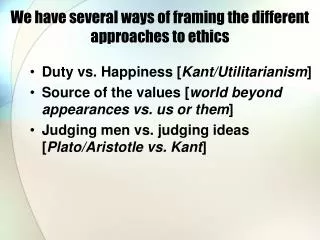
We have several ways of framing the different approaches to ethics • Duty vs. Happiness [Kant/Utilitarianism] • Source of the values [world beyond appearances vs. us or them] • Judging men vs. judging ideas [Plato/Aristotle vs. Kant]
With Mayo, Hugo, Aristotle and Nussbaum returning to the “judging of men.” Focus is on “virtue” rather than principles • What does this mean? • That the moral character of the person acting is important. • Why? • Because their actions flow from their character. • How is this different from William’s notion of person integrity? • Acting on the basis of principle vs. acting from your moral character.
What is the connection betweenbeing and doing? • You can only BE by doing what you do. • BEING focuses on VIRTUE & human character • Underlying question is whether a bad person can do good things. [on Utility yes, on Kant? Probably no]
Ideals [virtues & exemplars] vs Principles “What ought I do?” • Look for the moral principles and a connection with the current situation • OR quote a quality of character. • turns into “what ought I be?” Who is a saint? Who is a hero?
Saints & Heroes • An ideal type of character or an actual person • Plato: The just man • Aristotle: The man of practical wisdom • The role of ideals/exemplary people? examples?
Examples • Imitation – we try to be like our heroes • [Kant believes this is fatal to morality – why?] • Truth – George Washington • Others? Mother Theresa? Johnny Appleseed?
Mayo says there has been "...a radical one-sidedness in the philosophers' account of morality in terms of principles: it takes little or no account of qualities, of what people are. It is just here that the old fashioned word Virtue used to have a place; and it is just here that the work of Plato and Aristotle can be instructive.“ If we wish to enquire about Aristotle's moral views, it is no use looking for a set of principles. Of course we can find some principles to which he must have subscribed....The basic question for Aristotle, is not What shall I do? but, What shall I be?
Mayo asks: "Why should we expect that all rules of conduct should be ultimately reducible to a few?" • "A person's character is not merely a list of dispositions; it has the organic unity of something that is more than the sum of its parts." • Examples: Plato's "just man," • Aristotle's "man of practical wisdom," • Augustine's "citizen of the city of God," the "good communist," • Socrates, Christ, Buddha, and St. Francis.