Enhancing Clinical Readiness for Epic Implementation: The Partnership for Epic Preparedness
130 likes | 237 Vues
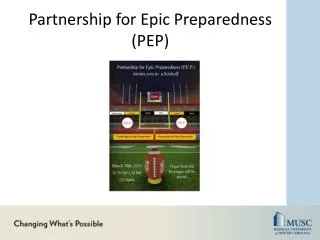
The Partnership for Epic Preparedness (PEP) is focused on improving patient safety, operational efficiency, and continuity of care through effective engagement and integration during Epic system implementation. By creating a clinical readiness program, PEP addresses issues that arise during installations, such as operational leadership engagement and training. The program establishes accountability, promotes education, and ensures ongoing communication with management, ultimately resulting in successful adoption of new technologies and better patient care practices.


Enhancing Clinical Readiness for Epic Implementation: The Partnership for Epic Preparedness
E N D
Presentation Transcript
Why Epic? • Patient Safety • Meaningful Use funding through better reporting • Improved Documentation • Integrated Communication • Continuity of Care • Evidence-based practice • Efficient operations • Health Information exchange
History Issue: Struggled to effectively engage operational leadership during the install. The result post go-live: • System worked, but operations was not prepared to use it • System set-up was not as expected • Management was not prepared for what to expect at go-live Solution: Created clinical readiness program
PEP Program Result: • Formalizes communication with operational management • Establishes owners for monitoring key metrics • Ensures strong operational involvement during implementation How: • Accountable individual owners • Education as appropriate • Participate in key events throughout the install • Appropriate expectations set for Go Live and after
Proposed Roles and Activities Roles • Clinical Readiness Lead –Andrea Coyle, RN • Clinical Readiness Owners Activities • Readiness Owner Kickoff* • Regular Clinical Readiness Owner meetings • Clinical Readiness Day
PEP Owner • Monitors needs and successes of department • Attend regular meetings • Participate in applicable project milestones • Understand high risk workflows and key metrics pertinent to area of accountability • Ensure staff attend training • Manage expectations • Monitor adoption and usage
Clinical Readiness Milestones 3 4 0-2
Between Now and Go-Live • The organization as a whole will be increasingly anxious, excited, confused, and hopefully, ready! • Be a steadying presence • Always remain calm • Understand the install plans and the controversial issues • Be careful to not overpromise – going live with new software is challenging
Between Now and Go-Live • Some individuals will oppose the project and express severe doubts. • Confront resistance early and strongly, yet be a positive presence during this time of change • Be an advocate, know why we are doing this project • Follow up on issues that cannot be resolved on the spot
Between Now and Go-Live • The Project Team will be busy • Acknowledge their efforts • Help them prioritize issues if they come to you with questions
Implementation Oversight Committees Project Workgroups “In the Weeds” work Pre-existing Committees/ Workgroups
eCareNet EDOC Epic Inpatient Governance Structure R. Freeman Inpatient Clinicals K. Burke Steering Committee EHR Development and Operations Council ClinDoc/Orders IOC Radiant IOC Lab IOC Stork IOC Beacon IOC Willow IOC Pre-existing Committees/ Workgroups Project Workgroups “In the Weeds” work
eCareNet Committee Executive VP Group EHR Development & Operations Council Executive Sponsor Dr. Bob Warren Epic Program Administrator Melissa Forinash Communications, Megan Fink PMO, Dan Furlong Periop Steering & ED IT Steering Committee Ambulatory Steering Committee Inpatient Steering Committee Revenue Cycle Steering Committee Analytics Development & Operations Council C. Carr S. Russell S. Harvey K.Weaver C. Liddy Gail Scarboro-Hrtiz R. Freeman J. Kratz K. Davis S. Miller Revenue Cycle J.Dell M.Balassone Inpatient Clinicals K. Burke Ambulatory EMR T.Walsh Training & Support N. Whichard Enterprise Reporting & Analytics M. Daniels Infrastructure & Technical Support K.Nendorf Emergency, OR, & Anesthesia B.Seyfried Enterprise Legend Advisory & Steering Groups Admins & Clinical Leads OCIO/IT Leads