Understanding Number Representation: Binary, Decimal, and Hexadecimal Systems in Computers
This guide explores how computers represent numbers using binary, decimal, and hexadecimal systems. We'll delve into binary representation, showcasing how binary digits (0s and 1s) correspond to powers of 2. You'll also learn how the decimal system represents numbers through base 10 and the unique hexadecimal system that utilizes base 16. Exercises are included to practice converting between these systems, as well as understanding the ASCII code for letters and digits. Perfect for beginners wanting to grasp number systems in computing!

Understanding Number Representation: Binary, Decimal, and Hexadecimal Systems in Computers
E N D
Presentation Transcript
How Computers Represent Numbers Binary Representations
Binary Code • A series of 1’s and 0’s • Place value is in powers of 2
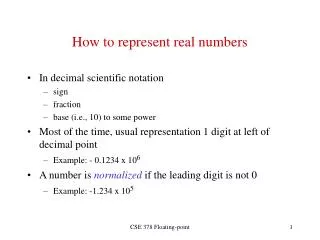
The Decimal System • Analyze the number 2,473 • 2,473 = 2 * 1000 + 4 * 100 + 7 * 10 + 3 *1 • 2,473 = 2 * 103 + 4 * 102 + 7 * 101 + 3 * 100 • Each position in a number represents a different power of 10 • Decimal is a base 10 system
Binary as Base 2 • (1011001)2 = 1*26 + 0* 25 + 1* 24 + 1* 23 + 0* 22 + 0* 21 +1* 20 • (1011001)2 = 1*64 + 0*32 + 1*16 + 1*8 + 0*4 + 0*2 + 1*1 • (1011001)2 = 64 + 16 + 8 + 1 • (1011001)2 = 89 (decimal)
Base 3 • (1011001)3 = 1*3^6 + 0*3^5 + 1*3^4 + 1*3^3 + 0*3^2 + 0*3^1 +1*3^0 • (1011001)3 = 1*729 + 0*243 + 1*81 + 1*27 + 0*9 + 0*3 + 1*1 • (1011001)3 = 729 + 81 + 27 + 1 • (1011001)3 = 838 (decimal)
Exercise • Find the decimal equivalent of (1011001)2 • 100111 = 1*2^5 + 1*2^2 + 1*2^1 + 1*2^0 • 100111 = 1*32 + 1*4 + 1*2 + 1*1 • 100111 = 32 + 4 + 2 + 1 • 100111 = 39 (decimal)
Hexadecimal System • Base-16 system • Needs digits 0 through 15 - we don’t have numbers for 10 - 15. • We use the letters A - F to represent the numbers 10 - 15.
Exercise • What would 3B in hexadecimal be in decimal? • 3B = 3 * 16 ^ 1 + 11 * 16 ^ 0 • 3B = 3 * 16 + 11 * 1 • 3B = 48 + 11 • 3B = 59 (decimal)
More on hexadecimal • 4 binary digits equal one hexadecimal number • 0101 (binary) = 5 (hex) • 1101 (binary) = D (hex) • 1011101 (binary) = 93 (decimal) = 5D (hex)
Divide by 2 and keep track of the remainders. 39 (decimal) = 100111 (binary) Decimal to Binary
Exercise • Convert 89 (decimal) to binary • 89 (decimal) = 1011001 (binary)
Why use binary? • Binary uses more digits than decimal, so why do we use it? • Electronic hardware can either be ‘on’ or ‘off’ - nothing in between. • Binary fits this pattern - ‘on’ state is 1 in binary and ‘off’ state is 0 in binary.
Numeric Representation of Letters and Digits • In a computer, letters and digits are represented by numeric codes. • Example Code: • What does this say? 8 9 3 12 1 19 19
ASCII and EBCDIC • The 2 most common codes used in computers are ASCII (American Standard Code for Information Interchange) and EBCDIC (Extended Binary Coded Decimal Interchange Code). They provide codes for letters, digits, punctuation marks, and other special characters.