Download
1 / 53
540 likes | 669 Vues
The Reconstruction Era (1865-1900) was a complex period following the American Civil War marked by efforts to rebuild the nation and integrate formerly enslaved people into society. It involved a fierce political struggle between Republicans and Democrats, North and South, and whites and blacks. Key milestones included the abolition of slavery through the 13th Amendment, the establishment of the Freedmen's Bureau, and the fight over civil rights and racial equality. Despite significant achievements, deep-seated conflicts and societal challenges persisted, shaping the narrative of modern America.

E N D
Reconstruction:1865-1900 Richard Jensen & D’Ann Campbell July 2011
Painful subject for 140 years • Who won, who lost? • White vs Black • Republican vs Democrat • North vs South • 2nd Reconstruction = Civil Rights Movement of 1960s • Confederate flag issue today
What was “reconstruction” • Rebuilding “a new nation” • Strict adherence to republican values • Rebel states readmitted only if proven to be true to republicanism • Until then, ruled by US Army • = the opposite of democracy
Three war goals • 1. Restore Union; destroy Confederacy • Surrender of all Confederate forces • 2. Complete abolition of slavery • Emancipation Proclamation (Jan 1, 1863) • 1/3 slaves freed by advancing armies • 13th Amendment (Feb - Dec 1865) • 3. Never again = new birth of strong nation; modernization of America
Emancipation • Lincoln plan: buy the slaves; refused • Emancipation Proclamation (Jan 1863) • Enforced by US Army as it moved South • 1/3 freed by Army; 2/3 by surrender in 1865
Cost of Freedom • Freedom = poverty & unemployment • and massive death toll from disease, hunger • Freedman Bureau = solve these • also special courts for Freedmen
Racial Equality a Goal? • Racial equality goal? • Promoted by abolitionists • Democrats denounce this goal • oppose Lincoln’s war effort • demand Peace & old Constitution As It Was • Lincoln denies equality as war goal
Republicanism • Constitution “guarantees a republican form of government” to states • Main justification for Reconstruction • i.e. truly republican citizens • loyal to USA , and not to Confederacy • ALERT: do not confuse with Republican Party. (The Democrats were just as “republican”)
13-14-15th Amendments • Lincoln & 13th: abolish slavery • 15th: all men right to vote • 14th: • Dual citizenship • Due process • Equal protection
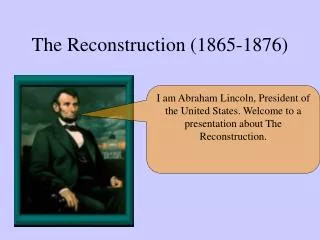
Lincoln Assassinated • His plan to win back white southerners • His plan for blacks: • recommend vote for veterans & educated • Strongly opposed by Radicals • Assassination stuns the nations • calls for vengeance; hang the conspirators • “Hang all traitors!” say Radicals • Lincoln’s coalition leaderless
Who Was President Johnson? • Personality: secretive, incompetent • Hates rich slaveowners • His were seized by Confederacy • Very poor coalition builder • Early 1865: seen as ultra radical • Southerns beg for pardons & get them
Johnson’s policy • Criteria:for Victory • Surrender & no guerrilla war • accept 13th Amendment & abolish slavery • repeal secession laws • take oath for future allegiance • Completed: summer 1865 • accepted by southerners & northern Democrats • War’s over! They say. But GOP disagrees
Johnson proclaims victory re 3 war goals • 1. Restore Union; destroy Confederacy • No attacks on US troops or courts • 2. Complete abolition of slavery • 13th Amendment ratified • Black codes passed to regulate new status • 3. Never again • Confederate leaders seek and get presidential pardons
Who Decides? • When: when to declare war over? • Who: who would decide, President or Congress? • Answer: the voters of the North decided through elections, 1866 through 1876 • 1866, 1868 and 1872: not over yet • 1874, 1876: yes it’s all over
Presidential Reconstruction 1865-66: Moderate Rule in South, • Terrible devastation • High level local violence • Ruined Economy; loss of banks, railroads, businesses, plantations • Cotton prices down, but only option • sharecropping system • Leaders = prewar modernizing Whigs
1865: Northern Vengeance • Treason trial for Jeff Davis? No • Wartime hatreds, caused by casualties • But Union soldiers admire Rebs’ courage • Assassination of Lincoln • hang Booth’s conspirators • Atrocities, Prisoners • Hang commandant of Andersonville Prison • Bloody Shirt campaign issue for 20 yrs
Radical Leaders: Sumner, Stevens radical rhetoric
Radicals: NO! war goals unmet • 1. Restore Union; destroy Confederacy • Still rebels at heart; hate the Yankees • 2. Complete abolition of slavery • Black codes = a sort of slavery • Freedman’s Bureau needed for transition • Civil Rights bill needed • 3. Never again • US Soldiers must occupy south • Long term: Blacks must share power
Radicals • Dominant in GOP • Strong religious element • Dominate Congress (but not Army ) • Abolish all forms of slavery • Riots & Black codes = violate this provision • loyal to USA • repeal secession laws not enough • Rebels will never be true Americans • take “iron-clad” oath of past allegiance • Control by true “republicans”
Congress versus President • Johnson breaks with Radicals (led by Charles Sumner & Thaddeus Stevens) • AJ Vetoes Freedman Bureau Bill • AJ Vetoes Civil Rights Bill • Prevents passage of 14th Amendment • Critical Election of 1866: Congress wins, Johnson powerless; almost impeached
Radical Plan • Radical Reconstruction begins in 1867 • Close down civilian government • US Army rules throughout South • New Elections, new electorate: Black vote; disfranchise Confederate leaders • Radical GOP wins power, 14th Amdt ratified; states readmitted • Leaders: Rep. Thaddeus Stevens (Pennsy) & Senator Charles Sumner (of Mass.)
Impeachment • Political reasons: Johnson was frustrating will of Radicals in Congress • Legal reasons: he violated “Tenure of Office” Act (re Secty of War Stanton) • Fails: some Republicans vote to acquit • Johnson helpless anyway, as Congress rules over his veto
Republican Rule in South • Based on 4-way coalition • African Americans • Carpetbaggers (Yankees who moved South) • Scalawags (Southern white Republicans) • Support of US Government: especially Army, Courts, Congress, & presidential patronage • Every state had different pattern • Longest in SC, Louisiana, Florida
Grant Elected President 1868 and 1872 Democratic songs, 1868
Radical Rule in South • Republican “radical” Coalition = Black voters led by southern Unionists (“scalawags”) & newly arrived Yankees (“Carpetbaggers”) • Timing varies state by state • Blacks demand more and more power inside bitterly divided GOP • Quality of government: hotly debated; very high levels taxes & corruption; Railroad deals; public school system
Status of Freedmen • Freedman Bureau in control • promise of 40 acres & a mule? • Tense relations with whites; separation • Major political violence in New Orleans, Memphis, etc. • Labor force behavior • withdraw women & children; reject gang labor • Freedman’s Bureau: must have contracts • not given 40 acres & a mule • Freedman’s Bank -- $$ all lost • Set up churches; dominant ministers • Status: income higher than in slavery
Radical Goal: Modernize South • Forget past, look to future • Education for all • Publics schools • Separate for blacks and whites • Create black colleges • Build railroads • Spend $$$; heavy debts & taxes • Politicians keep the $$$ for themselves
Corruption Issue • Republicanism violated by high levels of corruption under Grant • very bad in most southern states (GOP) • 1872: Liberal Republicans reject Grant • half the Radicals decide the war is over
KKK Murder and threats New Orleans Riot 1874
3 Very Different KKKs • Same names & symbols, but not linked • 1: Reconstruction: violent • attacked Black voters 1866-68 • suppressed by Grant & US Army • 2: 1920’s nationwide, moralistic • pure 100% Americanism • peak in 1923; collapsed by 1925 • 3: Post WW2: fringe groups • David Duke and Louisiana politics
Grant’s 2nd term disaster • Patronage and corruption more important than republicanism • Army props up radical Republicans in deep South • Depression of 1873 hits nation • Democrats come back in 1874 • Isn’t the war over yet???
Redemption, 1870-76: return of conservative white Democrats • Ku Klux Klan tries to stop Black voting • battles US Army, black state militia • Klan defeated by Grant administration • Conservatives rally all white voters • and purchase 20-50% of black vote • violence in some cases (Mississippi) • state after state captured by Redeemers
Compromise of 1877 Ends Reconstruction • Tilden (D) wins more popular votes than Hayes (R) • but Electoral College in doubt • Compromise commission selects Hayes • He removes all federal troops (they violate republicanism) • GOP toppled in last three states (LA, SC, FL) • Bitterness lasts 100 years; “damnyankees”
Long Term Results: War goals achieved • Slavery ended but blacks become 2nd class citizens; lose the vote after 1890 • Confederacy dead; Rebs = Americans • Modernization speeds up in North • Business booms; era of Free Enterprise • South becomes poor “Third World” backwater • Texas best off in South, but still poor
Long Term Results: 13-14-15th Amendments • Lincoln & 13th: abolish slavery • 15th: all men right to vote • Not enforced 1890-1964 • 14th: • Dual citizenship • Due process • Equal protection • Most important part of Constitution
What about three war goals? • 1. Restore Union; destroy Confederacy • Accomplished –even die hards agreed • 2. Complete abolition of slavery • Accomplished. No efforts to turn back • But Blacks got 2nd class citizenship • 3. Never again = new birth of strong nation; modernization of America • Accomplished, but came slowly to South
After Reconstruction • 1872: “Liberal Republicans” revolt • Populist revolt of poor white farmers fails (1890-96) • PLESSY V. FERGUSON (1896) Segregation ok’d by Supreme Court Disfranchisement (1890s) • Lynchings & racial violence (1890-1920) • NAACP formed (1906)
Blacks as 2nd Class Citizens • Loss of Political Power • Segregation • Poor services (schools) • Sharecroppers • Some Farm Owners • Leaders: ministers & teachers