Strengthening Cross-Departmental Coordination for Enhanced Futures Research in Policy
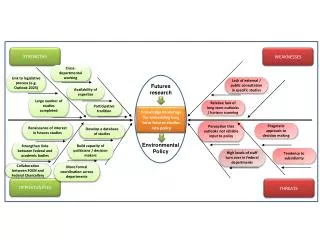
This document outlines the strengths and weaknesses of cross-departmental collaboration in legislative processes, particularly in the context of futures studies. While there has been a renaissance of interest in futures research and a participative tradition in policymaking, challenges such as a lack of external consultation and unreliable long-term outlooks persist. The need to develop a comprehensive database of studies and strengthen links between federal and academic bodies is highlighted as crucial for informed decision-making. Emphasizing a pragmatic approach, this initiative aims to build the capacity of politicians and decision-makers for better environmental policy integration.

Strengthening Cross-Departmental Coordination for Enhanced Futures Research in Policy
E N D
Presentation Transcript
STRENGTHS WEAKNESSES Cross-departmental working Link to legislative process (e.g. Outlook 2025) Lack of external / public consultation in specific studies Futures research Availability of expertise Large number of studies completed Relative lack of long-term outlooks / horizon scanning Participative tradition Knowledge brokerage for embedding long term futures studies into policy Perception that outlooks not reliable input to policy Renaissance of interest in futures studies Pragmatic approach to decision making Develop a database of studies Environmental Policy Build capacity of politicians / decision makers Strengthen links between federal and academic bodies Tendency to subsidiarity High levels of staff turn over in Federal departments More formal coordination across departments Collaboration between FOEN and Federal Chancellery OPPORTUNITIES THREATS