
SlideServe
Menu
Préférences
© SlideServe · v2026

Evolutionary Lessons with Lego Robots: Understanding Natural Selection

fynn avatar
42 diapositives · 573 Views · Jul 27, 2014

Explore the fascinating concept of natural selection through hands-on learning with Lego robots. By constructing different "Evobots" adapted to various environments, participants will observe how organisms evolve traits that enhance their survival and reproduction. Each Evobot will be designed to thrive in specific challenges like speed, climbing, or resource efficiency. This interactive lesson highlights the evolutionary journey from ancestral forms to specialized adaptations, teaching valuable insights into adaptation and environmental fitness.
Evolutionary Lessons with Lego Robots: Understanding Natural Selection - slide 1
01 / 42Evolutionary Lessons with Lego Robots: Understanding Natural Selection
1 / 17

Télécharger la présentation

Evolutionary Lessons with Lego Robots: Understanding Natural Selection
Une image / un lien ci-dessous est fourni (tel quel) pour télécharger la présentation

Politique de téléchargement : le contenu du site vous est fourni TEL QUEL pour votre information et votre usage personnel ; il ne peut être vendu, concédé sous licence ni partagé sur d’autres sites sans l’accord de son auteur.Le contenu vous est fourni TEL QUEL, pour votre information et votre usage personnel uniquement. Téléchargez la présentation en cliquant sur ce lien. Lors du téléchargement, si vous ne parvenez pas à télécharger une présentation, l’éditeur a peut-être supprimé le fichier de son serveur.Pendant le téléchargement, si vous ne parvenez pas à obtenir une présentation, le fichier a peut-être été supprimé par l’éditeur.

F I N

Plus de contenu associé

Transcription de la présentation
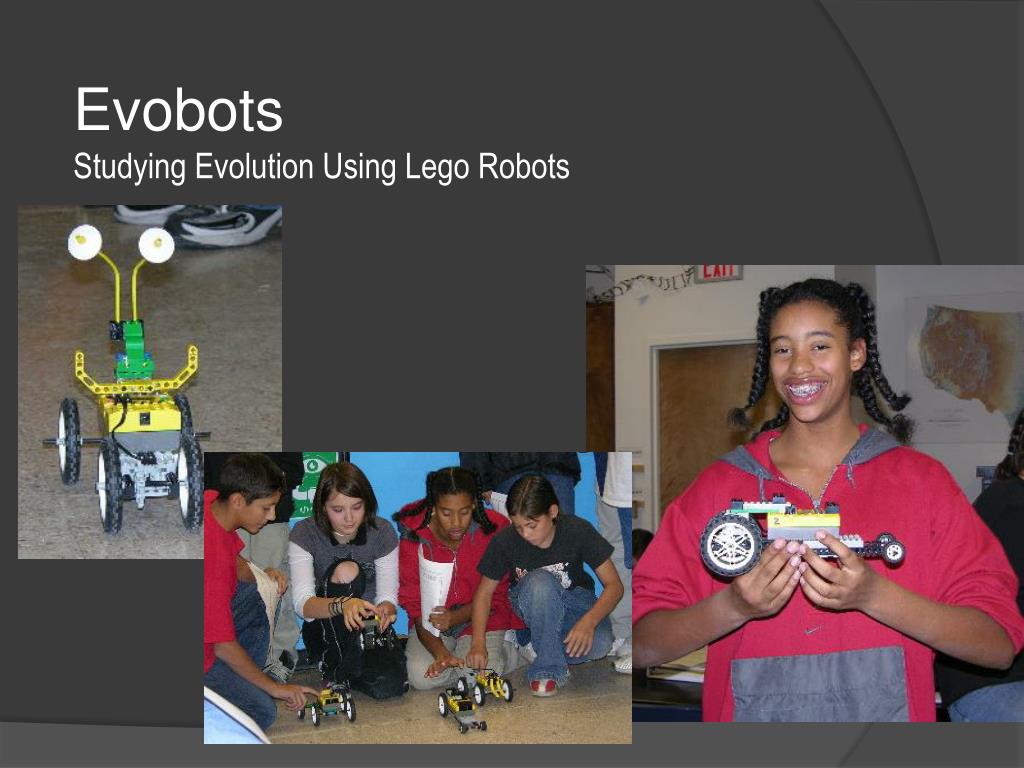
  1. EvobotsStudying Evolution Using Lego Robots

  2. Natural Selection • Natural selection is a process that causes heritable alleles that are helpful for survival and reproduction to become more common, and harmful alleles to become more rare. • This occurs because organisms with “better” alleles pass on more copies of these heritable traits to the next generation

  3. Adaptations • Adaptations are the characteristics that give individuals better chances of surviving and or reproducing.

  4. Car #1 What is this car adapted for?

  5. Car #1 Adapted for s p e e d

  6. Car #1 This Pronghorn Antelope is also adapted for speed. Adapted for s p e e d

  7. Car #2 What is this car adapted for?

  8. Car #2 Adapted for CLIMBING

  9. Car #2 This big horned sheep is also adapted for climbing. Adapted for CLIMBING

  10. Car #3 What is this vehicle adapted for?

  11. Car #3 Adapted for water and land-- amphibious

  12. Car #3 This tiger salamander is also adapted for a life in both land and water. Adapted for water and land-- amphibious

  13. Car #4 What is this vehicle adapted for?

  14. Car #4 Adapted for safety and protection

  15. Car #4 This desert tortoise is also adapted for safety and protection. Adapted for safety and protection

  16. Car #5 What is this vehicle adapted for?

  17. Car #5 Adapted as a generalist. It’s good at a lot of things but not great at any.

  18. This coyote is also a generalist. It is medium speed, ok at climbing… Car #5 Adapted as a generalist (speed, protection, climbing…)

  19. Car #6 Toyota Prius (Hybrid)

  20. Car #6 Toyota Prius (Hybrid) Adapted to use less resources

  21. This kangaroo rat also survives with few resources. Car #6 Toyota Prius (Hybrid) Adapted to use less resources

  22. The Ancestral State • This is a photo of the first car, a Model-T Ford. • All the cars we just looked at evolved from this original

  23. All the cars have a common ancestor but are now adapted for different environments. The Ancestral State Notice how the Toyota Prius evolved from the Toyota Camry. This is a more recent ancestor for the Prius.

  24. A Tale of Intermediate Forms • When looking at a 1909 Model-T Ford and a 2010 Ford Mustang it is hard to see how we got from one to the other– they look so different. ?

  25. A Tale of Intermediate Forms • However, if we look at the history of cars, we get a better picture 1909 1920

  26. A Tale of Intermediate Forms 1909 1920 1927

  27. A Tale of Intermediate Forms 1909 1920 1927 1932

  28. A Tale of Intermediate Forms 1909 1920 1927 1932 1938

  29. A Tale of Intermediate Forms 1909 1920 1927 1932 1938 1948

  30. A Tale of Intermediate Forms 1909 1920 1927 1932 1938 1948 1952

  31. 1909 1920 1927 1932 1938 A Tale of Intermediate Forms 1948 1952 1960

  32. 1909 1920 1927 1932 1938 A Tale of Intermediate Forms 1948 1952 1960 1964

  33. 1909 1920 1927 1932 1938 A Tale of Intermediate Forms 1948 1952 1960 1964 1968

  34. 1909 1920 1927 1932 1938 A Tale of Intermediate Forms 1948 1952 1960 1964 1968 1975

  35. 1909 1920 1927 1932 1938 A Tale of Intermediate Forms 1948 1952 1960 1964 1968 1985 1975

  36. 1909 1920 1927 1932 1938 A Tale of Intermediate Forms 1948 1952 1960 1964 1968 1975 1995 1985

  37. 1909 1920 1927 1932 1938 A Tale of Intermediate Forms 1948 1952 1960 1964 1968 1975 1985 1995 2005

  38. 1909 1920 1927 1932 1938 A Tale of Intermediate Forms 1948 1952 1960 1964 1968 1975 1985 1995 2010 2005

  39. 1909 1920 1927 1932 1938 A Tale of Intermediate Forms 1948 1952 1960 1964 1968 1975 1985 1995 2005 2010

  40. Evobot Lesson • Together we will all build an ancestral state. • Then, you will have 30 minutes to develop a Evobot to compete in a specific environment.

  41. Environments • Flats (The fastest evobot has the advantage) • Mountains (The evobot that can climb the steepest hill has the advantage)

  42. Environments • Founder (The evobot that is completed first has an advantage) • Desert (The evobot that uses the least legos or resources gains an advantage) • Reproduction (The best looking evobot and the weirdest looking evobot gain an advantage)