SlideServe
Menu
Préférences
© SlideServe · v2026

Stateless IPv4 in IPv6: The 4rd Softwire Methodology for Dual-Stack Networking

gabe avatar
8 diapositives · 222 Views · Aug 14, 2014

This draft outlines the 4rd softwire methodology enabling efficient IPv4 services over IPv6 infrastructures. The approach focuses on stateless address mapping and provisioning through DHCPv6, facilitating seamless IPv4-in-IPv6 encapsulation and decapsulation. Leveraging anycast for load balancing and resiliency, the architecture provides dual-stack services while ensuring that IPv4 traffic naturally aligns with IPv6 routing. This document emphasizes practical applicability, configuration simplicity, and support for a wide range of customer IPv4 addresses derived from a shared IPv6 prefix.
Stateless IPv4 in IPv6: The 4rd Softwire Methodology for Dual-Stack Networking - slide 1
01 / 8Stateless IPv4 in IPv6: The 4rd Softwire Methodology for Dual-Stack Networking
1 / 17

Télécharger la présentation

Stateless IPv4 in IPv6: The 4rd Softwire Methodology for Dual-Stack Networking
Une image / un lien ci-dessous est fourni (tel quel) pour télécharger la présentation

Politique de téléchargement : le contenu du site vous est fourni TEL QUEL pour votre information et votre usage personnel ; il ne peut être vendu, concédé sous licence ni partagé sur d’autres sites sans l’accord de son auteur.Le contenu vous est fourni TEL QUEL, pour votre information et votre usage personnel uniquement. Téléchargez la présentation en cliquant sur ce lien. Lors du téléchargement, si vous ne parvenez pas à télécharger une présentation, l’éditeur a peut-être supprimé le fichier de son serveur.Pendant le téléchargement, si vous ne parvenez pas à obtenir une présentation, le fichier a peut-être été supprimé par l’éditeur.

F I N

Plus de contenu associé

Transcription de la présentation
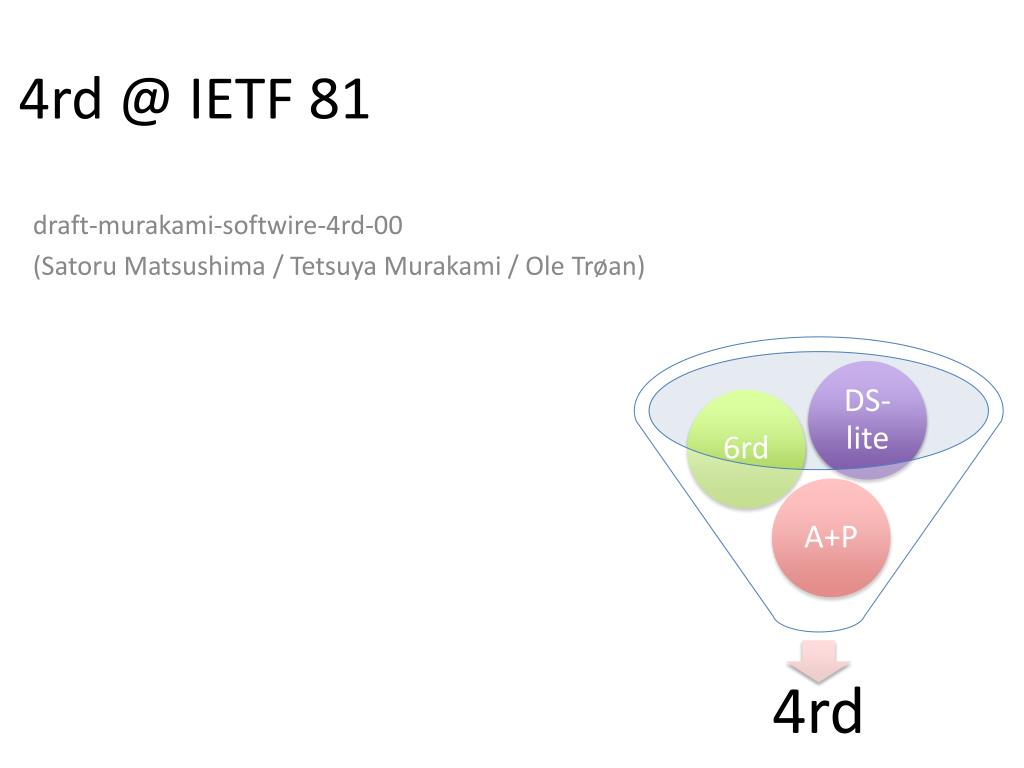
  1. 4rd @ IETF 81 draft-murakami-softwire-4rd-00 (Satoru Matsushima / Tetsuya Murakami / Ole Trøan)

  2. Draft history Motivation draft: draft-operators-softwire-stateless-4v6-motivation-02 Applicability statement: draft-sun-intarea-4rd-applicability-01 DHCPv6 option: draft-mrugalski-dhc-dhcpv6-4rd-00

  3. 4rd in One Slide Subscriber IPv4 address or prefix derived from IPv6 address “One line” global config for IPv6 Gateway 4rd IPv4 + IPv6 IPv4 + IPv6 IPv4 + IPv6 • Native dual-stack IP service to the Subscriber • Simple, stateless, automatic IPv4-in-IPv6 encap and decap functions • IPv4 traffic automatically follows IPv6 Routing • BRs placed at IPv4 edge, addressed via anycast for load-balancing and resiliency • Defined in draft-murakami-softwire-4rd 4rd 4rd Dual Stack Core CE 4rd Border Relays 4rd IPv6

  4. Comparison

  5. 4RD : Stateless Address Mapping • Provisioning based on elements that are: • Well known • Derived from IPv6 provisioning • Provisioned via DHCPv6 • Embedded in address 48bit(IPv4 + Port) 32bit Port Set ID Domain IPv4 prefix EA-bits Port Head Port 0 0 0 1 0 0 1 0 1 1 Domain IPv6 prefix EA-bits Suffix Interface ID 128bit

  6. IPv4 Address Sharing – Port-set ID deriving If there is a remainder of EA bits, this part will be treated as Port-set ID. IPv4 Internet CE IPv6 prefix (max 64bits) Domain IPv6 prefix EA bits 4rd BR CE 4rd prefix (33~47 bits) Domain IPv6Prefix: 2001:db8::/32 ISP’s IPv6 Network EA bits Domain 4rd prefix IPv4 shared address (32 bits) Port-set ID (max 15 bits) 4rd CE1 4rd CE3 4rd CE2 The Port-set ID is 8 bits, so 256 customers can share one IPv4 address of 192.0.2.205. CE IPv6Prefix: 2001:db8:cdab::/48 CE IPv6 Prefix: 2001:db8:cda1::/48 CE IPv6Prefix: 2001:db8:cdef::/48 Shared IPv4 Address: 192.0.2.205 Shared IPv4 Address: 192.0.2.205 Shared IPv4 Address: 192.0.2.205 Port-set ID: 0xab Port-set ID: 0xef Port-set ID: 0xa1 6

  7. Port allocation algorithms:

  8. Next: • WG adoption