Ideal Work-Based programs
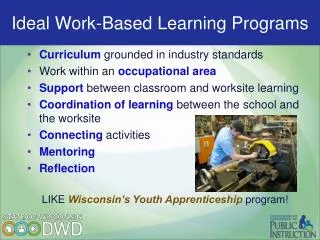
Ideal Work-Based Learning Programs. Ideal Work-Based programs. Curriculum grounded in industry standards Work within an occupational area Support between classroom and worksite learning Coordination of learning between the school and the worksite Connecting activities Mentoring

Ideal Work-Based programs
E N D
Presentation Transcript
Ideal Work-Based Learning Programs Ideal Work-Based programs • Curriculum grounded in industry standards • Work within an occupational area • Support between classroom and worksite learning • Coordination of learning between the school and the worksite • Connecting activities • Mentoring • Reflection LIKE Wisconsin’s Youth Apprenticeshipprogram!
Why YA? WHY YA? • Employers complained about a lack of skillsin youth • High youth unemployment • WI needed a standard school to work transitionsystem for students not going to college (The “Forgotten Half”) • Education needed a way for youth to apply classroom learning to a work setting • Existing co-op & job shadows were inconsistent across WI AND do not allow enough time for skill development
Key Design Concepts • Preparation for entry level jobs • Expanded to college bound students • At least 2 years • One or Two year options now • Comprehensive occupationally • 40 career training options • First StatewideStandardized Skill Competencies, Driven by Employers
Core Program Elements • Skills aligned with National & Industry skill standards • Skills reviewed by Employers! • Revised using Career Pathways model • Employability, Safety & Security skills standardized across YA programs • Standard curriculum structure
Employer Driven! • Employer Mentors train, support, and guide students to learn the employability, safety, and technical skills listed on the Skills Standards Checklist • YA Consortium Coordinators recruit & link students & businesses together; train mentors; and coordinate classroom & worksite activities and documentation
YA Students say… Follow-up Reports Center on Education and Work, UW Madison most recent 2005 YA Student Graduates Report: • 87% employed either PT or FT • 86% & 82% report applying communication and problem solving skills learned in YA to their current jobs • 78% enrolled in post-secondary education during the time after HS YA Employer Report: • 86% employ 1-3 students • 60% of employers offered incentives to further their YA students education • 98% report deriving benefit from participating in the program stating; provides a community service, helps recruit new employees, allows training to company standards • 97% would recommend it to other employers
YA Recognized! YA Recognized • YA- Video Testimonials 1; 2;3 • Madison PBS- BluePrint Learning for Life(13.18) & BTCI(12.28) (NOV 2010) • YA mentioned on page 32 of Harvard report as an “Exemplar of Employer Engagement” AND EACH time Bill speaks in WI (FEB 2011) • “America’s misplaced disdain for vocational education” in The Economist (JUN 2010) • “Teenagers in need of direction can turn to apprenticeships” and “What if college education just isn’t for everyone?” in USA Today (MAR 2010) • In The Means to Grow Up by R. Halpern page 60
Grant Funding • State Biennial Budget • Grant funds available each year through DWD via annual application process to eligible applicants • Funding helps support ALL WBL activities at schools • Free, Employer-reviewed Curriculum • School based STW Coordinators • Child Labor Law Guidance • Tech College Articulation Guidance • Online YA Resources for all WBL Programs • Connections to WIBs, Employers, LMI, Schools
Impediments OR…Why are we not to scale? • Employer Participant Numbers • Employer Incentives • Employer Concerns (Child Labor Laws/Liability) • Funding Restrictions • Job Availability/Recession • Marketing/Awareness Campaign • Limited Resources