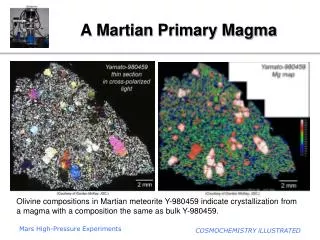
A Martian Primary Magma
40 likes | 189 Vues
The study of the Martian meteorite Y-980459 reveals that its olivine compositions suggest crystallization from magma with a similar composition to the bulk of the meteorite. High-pressure experiments indicate that the magma contains both olivine and pyroxene at a pressure of about 12 kbar, correlating with a depth of 100 km on Mars. The residual minerals of the Martian mantle, with an Mg# of 0.86, imply a low degree of melting, challenging previous assumptions about the Martian mantle's homogeneity and melting dynamics.


A Martian Primary Magma
E N D
Presentation Transcript
A Martian Primary Magma Olivine compositions in Martian meteorite Y-980459 indicate crystallization from a magma with a composition the same as bulk Y-980459. COSMOCHEMISTRY iLLUSTRATED
High-Pressure Experiments Experimental apparatus and SEM image of an experimental run product. COSMOCHEMISTRY iLLUSTRATED
Experimental Results • Series of experiments allows construction of a phase diagram • The magma has both olivine and pyroxene on its liquidus at about 12 kbar (depth of 100 km in Mars) • Unless the amount of partial melting was extremely large, this is likely the pressure at which the magma formed COSMOCHEMISTRY iLLUSTRATED
The Martian Mantle • At multiple saturation, residual minerals have Mg# of 0.86 • This implies that the mantle source region for Y-098459 had this value if the amount of melting was very low • Consensus value for Martian mantle is Mg# of 0.75, implying very high % melting Options: - Martian mantle Mg# is > 0.75, - Martian mantle is heterogeneous - Y-098459 source was melted more than once COSMOCHEMISTRY iLLUSTRATED