Download
1 / 8
80 likes | 192 Vues
This guide explores the fundamental principles of balance, focusing on the ability to maintain one's center of gravity over a base of support. It explains the significance of static and dynamic balance in various activities, highlighting how a larger base enhances stability. Key concepts such as body tension and center of gravity are detailed, illustrating their role in sports and physical activities. The document also includes reflective questions to deepen understanding, making it a valuable resource for learners interested in mechanics and movement techniques.

E N D
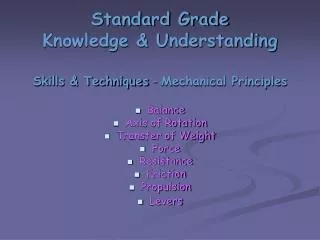
Standard Grade Knowledge & Understanding Skills & Techniques - Mechanical Principles • Balance
Balance • Balance is the ability to retain the centre of gravity over your base of support. • Balance – The ability to remain balanced depends on 2 things: • A) Base of Support • B) Centre of Gravity • If your base of support is large your balance will be more stable • If your base of support is small, it is harder to keep your balance
Balance • To remain balanced for a period of time, you have to tighten the muscles in your body – this is called body tension • The exact muscle requirements depend upon the nature of the task. • Static balances such as headstand in gymnastics require you to hold a balance • Dynamic balances require you to maintain balance under constantly changing conditions. When skiing you constantly adjust your dynamic balance as you travel over changing terrain in order to remain balance Static Dynamic
Centre of Gravity • Centre of Gravity – is your point of balance. When standing upright it is near your belly button • If your centre of gravity is low you will balance more easily • If you move your centre of gravity outside your base of support, you will lose your balance.
Good balance is very important to be successful in lots of activities: A large base allows the golfer to be balanced in preparation for his swing Having his centre of gravity over his base allows the footballer to be balanced during his shooting action A low centre of gravity allows a volleyball player to remain balanced when performing a dig
Questions • On a A4 sheet of paper answer the following: • What is balance? • What is body tension? • Describe two points about your centre of gravity which will help you remained balanced.
Evaluating • What is the phase we use to remember Evaluating!?!?! • With your partner complete the table!