Download
1 / 3
40 likes | 233 Vues
This article explores the crucial elements of carbon and silicon, highlighting their allotropes such as diamonds, graphite, and buckminsterfullerene. It defines carbon-containing compounds as organic compounds and discusses the characteristics of Group 14 elements, which include metals, non-metals, and metalloids. Additionally, the article covers methods for isolating nitrogen, specifically through distillation from liquid oxygen, and introduces the Haber process for ammonia synthesis. The stability of nitrogen due to its triple bond is also examined.

E N D
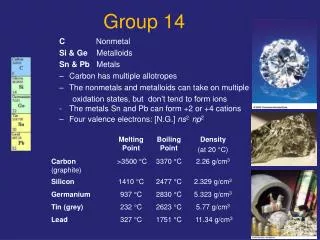
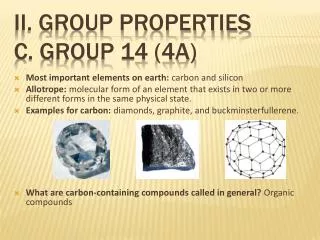
Most important elements on earth: carbon and silicon • Allotrope: molecular form of an element that exists in two or more different forms in the same physical state. • Examples for carbon: diamonds, graphite, and buckminsterfullerene. • What are carbon-containing compounds called in general? Organic compounds ii. Group propertiesC. Group 14 (4a)
This group has all three different categories of metals: metals, non-metals, metalloids One method used to isolate pure N2: combine and then distill it from a liquefied oxygen. Liquid nitrogen distills off first because it has a lower boiling point than liquid oxygen. The Haber process is used to make ammonia by combining hydrogen and nitrogen. Fe Reaction for the Haber process: N2 (g) + 3H2 (g) ⇔ 2NH3 (g) N2 is extremely stable because it has a triple bond. D. Group 15 (5a)