Download
1 / 15
150 likes | 269 Vues
This course, taught by Instructor Lau Lap Chi, explores essential mathematical concepts pivotal for computer science, including counting, logic, proofs, and graph theory. Through lectures and tutorials, students will engage with fundamental ideas and develop problem-solving skills relevant to algorithms, data structures, and artificial intelligence. The course utilizes "Discrete Mathematics with Applications" by Susanna S. Epp and includes quizzes and a final exam to assess understanding. Students are encouraged to actively participate and adhere to academic honesty principles.

E N D
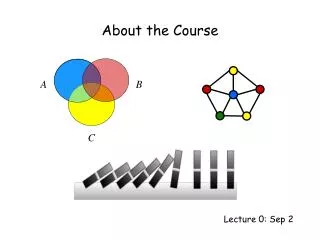
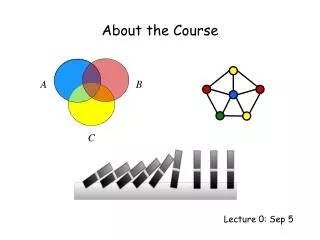
A B C About the Course Lecture 0: Sep 5
Plan • Course Information and Arrangement • Course Requirement • Topics and objectives of this course
Basic Information • Course homepage: http://www.cse.cuhk.edu.hk/~chi/csc2110/ • Newsgroup: cuhk.cse.csc2110. at news.cse.cuhk.edu.hk • Instructor: Lau, Lap Chi • Office hour: Thesdays, Thursdays, 10am-12pm (SHB 911) • Lectures: M7-8 (SC L1), W6 (SC L1) • Tutors: Kwok Tsz Chiu Wong Chun Hoi (Hollis) Yu Yuanming • Tutorials: W10 (LSB C2) or H5 (ERB 803) or H6 (LSB C1)
Course Material • Textbook: Discrete Mathematics with Applications Author: Susanna S. Epp Publisher: Brooks/Cole • Notes: Course notes from “mathematics for computer science” http://courses.csail.mit.edu/6.042/spring07/ (available to be downloaded in the course homepage)
Course Requirements • Quizzes, 45% • Final Exam, 55% Three Quizzes: (1) Sep 26 (Monday), in class (2) Oct 24 (Monday), in class (3) Nov 28 (Monday), in class
A B C Topic 1: Counting • Sets and Functions • Combinations, Permutations, Binomial theorem • Counting by mapping, pigeonhole principle • Recursions Probability, data structures, algorithms
Topic 1: Counting How many steps are needed to sort n numbers? Algorithm 1 (Bubble Sort): Every iteration moves the i-th smallest number to the i-th position Algorithm 2 (Merge Sort): Which algorithm runs faster?
Topic 2: Logic and Proofs How do computers (and humans) think? Logic: propositional logic, first order logic Proof:induction, contradiction Artificial intelligence, database, circuit, algorithms
Topic 3: Graph Theory • Graphs • Degree sequence, Eulerian graphs, isomorphism • Trees • Matching • Coloring Computer networks, circuit design, data structures
Topic 3: Graph Theory How to color a map? How to schedule exams? How to send data efficiently?
Objectives of This Course • To learn basic mathematical concepts, e.g. sets, functions, graphs • To be familiar with formal mathematical reasoning, e.g. logic, proofs • To improve problem solving skills, e.g. induction, recursion • To see the connections between discrete mathematics and computer science Knowledge will be used in future courses: CSC 2100, ERG 2040, CSC 3130, CSC 3160
Time Table (1) Tutorials (2) Office hours (3) TA office hours
Expectations CUHK staff student expectations on teaching and learning http://www.cse.cuhk.edu.hk/~chi/csc2110/notes/expectation.doc No electronic devices in class, including phones, laptops, iPads, etc.
Academic Honesty http://www.cuhk.edu.hk/policy/academichonesty/ Definition: see booklet and http://www.cuhk.edu.hk/policy/academichonesty/p01.htm Examples: see booklet and http://www.cuhk.edu.hk/policy/academichonesty/p02.htm Procedure: see booklet and http://www.cuhk.edu.hk/policy/academichonesty/p06.htm • Computer programs checking plagiarism • Discussions of ideas may be allowed, in any case need to write your own solutions. • State the source and let the marker make the adjustments. Academic Honesty in the Faculty of Engineering: http://www.cse.cuhk.edu.hk/~chi/honesty.ppt