Fault-Tolerant Workflow Scheduling in Cloud Computing: Challenges and Innovative Solutions
100 likes | 219 Vues
Scheduling workflows in cloud computing environments with strict deadlines presents complex challenges, compounded by issues of resource availability, access control, and potential failures. The main aim is to execute workflows within deadlines despite possible failures. A proposed solution involves task replication and resubmission based on priority, minimizing resource waste while achieving a successful execution rate. Additionally, predicting remaining service execution time using stochastic Petri nets offers dynamic process tracking and improved resource scheduling.


Fault-Tolerant Workflow Scheduling in Cloud Computing: Challenges and Innovative Solutions
E N D
Presentation Transcript
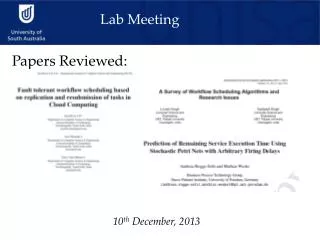
Lab Meeting Papers Reviewed: 10th December, 2013
1 Fault tolerant workflow scheduling • Primary Issue : • Scheduling workflows in a cloud environment, with deadlines, is a complex problem • Issues of shared resources, time to release, resource availability, access control during execution, failures, etc. • The main goal is to schedule workflows and execute these workflows within the deadline in-spite of many failures that occur in the environment. • Solution: • Use of replication and resubmission of tasks based on priority of task. • Need to avoid resource wastages • Heuristic metric finds trade-off between replication and resubmission factors without the need for history data 1. Fault tolerant workflow scheduling based on replication and resubmission of tasks in Cloud Computing. Jayadivya et. al.
1 Results Ratio of success rate and resource usage Failure Probability 1. Fault tolerant workflow scheduling based on replication and resubmission of tasks in Cloud Computing. Jayadivya et. al.
1 My Observations • Difficult to understand the relevance of the deadline to the success or failure curves • Failure probabilities for ‘with replication’ would be expected to be much better • Surprising result is Performance Comparison are similar – this is probably due to heuristic metric – which is not discussed in detail. • The mean number of replications necessary to achieve results is not specified 1. Fault tolerant workflow scheduling based on replication and resubmission of tasks in Cloud Computing. Jayadivya et. al.
2 Prediction of Remaining Service Execution Time • Primary Benefits: • Dynamic Process Tracking requires predicted remaining duration • It also assists scheduling of resources • It provides feedback to the client • Present State • Present methods update predictions on event arrival and subtract elapsed time • New Approach: • Also consider expected events that have not occurred • Prediction approach based on PN formalism so that concurrency can be modelled 2. Prediction of remaining service execution time using stochastic PN with arbitrary firing delays. Andreas Rogge-Solti et. al.
1 My Observations • Empirical Models are not use • Requires immediate notification of event • Simulations assume a stable state • In a real-time system this may not be feasible
Thank you…. QUESTIONS