Database Design
This document outlines a database design tailored for managing character and world representation in a game environment. It covers key components including character attributes (such as strength, speed, and intelligence), world navigation, non-playable character interactions, and essential categories like courses and prerequisites. Additionally, the knapsack system allows for the management of items students carry, showcasing unique properties such as unlimited weight and size. A detailed overview of faculty information and challenges enhances the structured organization for educational gameplay.

Database Design
E N D
Presentation Transcript
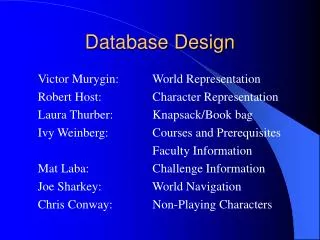
Database Design Victor Murygin: World Representation Robert Host: Character Representation Laura Thurber: Knapsack/Book bag Ivy Weinberg: Courses and Prerequisites Faculty Information Mat Laba: Challenge Information Joe Sharkey: World Navigation Chris Conway: Non-Playing Characters
World Representation By: Victor Murygin
The Coordinate Table • CoordinateID • X – number (size to be specified) • Y – number (size to be specified) • Z – number (size to be specified)
Explanation • Idea from graphics design • Original design (Room, Hallway, Hotspot) • Current design (Hotspot) • When a Hotspot needs to be accessed, get coordinates from the program • CoordinateID linked to Hotspot table • Program receives whatever is at the Hotspot • This design wouldn’t be possible with last year’s game
Character Representation By: Robert Host
Purpose • Character represents people in the game • Each character has his/her own attributes.
Character cont. • UserID – A unique identification name specified by the user. Limited to maximum of 8 characters. • Password – A string of characters that must match the specified UserID to allow access to the correct player.
Character cont. • Strength – Determines how much weight the character can carry. • Speed – Determines how fast a character moves throughout the Watson building • Persuasion – Determines how well the character can manipulate professors and TAs for help • Intelligence – Rises and falls based on answers to challenges, current GPA, and any other task requiring brain power.
Character cont. • GPA – Grade Point Average. Calculated based on grades in courses taken. • Money – Used to buy materials including books and junk food. • ChallengeSuccess – The number of challenges the character has successfully completed. • Courses Taken/In Progress – There will be a field for each course in the computer science curriculum. Each field will contain an integer value that can be easily converted into a letter grade. • GradeCS140, GradeCS328, GradeCS422, etc.
Knapsack&Object Table By: Laura Thurber
Knapsack • Purpose: • To provide students with a place to carry quest items/personal belongings • i.e. School books, BUC$ card, tests/paper challenges
Knapsack • Properties: • No size limit (can hold theoretically infinite number of Objects). • No weight limit • May have different appearances (i.e. Prada bookbag, L.L Bean bookbag, Wimpy Art Student Portfolio, Laptop carrying bag, Moogle Slave, Freshman Slave, etc)
Knapsack • Fields: • SizeLimit (Integer) [not implemented, but included in case it is implemented in the future] • ItemName (Comma-separated list) • Image (String) [may not be implemented] • Style (String) [Description]
Object • Purpose: • To identify those objects which are contained in a Knapsack. • i.e. BUC$ Card, book, instrument, laptop, pen, notebook
Object • Properties: • Weight (it doesn't matter, but if a weight limit is at any time implemented in Knapsack, this will be needed.) • Physical Description • Name
Object • Fields: • Name (String) • Weight (Integer) • Description (String)
Courses and Prerequisites&Faculty Information By: Ivy Weinberg
Course Table • The Course Table has 6 fields: • CourseID (Primary Key- AutoNumber) • CourseNumber (Required- Text) • CourseName (Required- Text) • CoreCourse (Required -Yes/No) • HotSpotID (Linked field) • ChallengeID (Linked field)
Tables Linked to Course • Prerequisite – linked by primary key CourseID • Faculty– linked by primary key CourseID • HotSpot – linked by HotSpotID • Challenge – linked by ChallengeID
Prerequisite Table • The Prerequisite Table has 5 fields: • PrerequisiteID (Primary Key- AutoNumber) • PrereqID (Required- Number) • PrerequisiteNumber (Required- Text) • PrerequisiteName (Required -Text) • CourseID (Linked field)
Faculty Table • The Faculty Table has 7 fields: • FacultyID (Primary Key- AutoNumber) • FacID (Required- Number) • FirstName (Required- Text) • LastName (Required -Text) • Phone (Not required - Text) • Email (Not required - Text) • CourseID (Linked Field)
Challenge Information By: Mat Laba
Component Detail • Each series of challenges will consist of five questions / answers • Each series will address specific topics as they relate to coursework which is part of the core computer science curriculum at SUNY Binghamton.
Component Detail cont. • A series of challenges were collected for the following courses: • CS133 Introduction to C / C++ • CS210 Logic Design • CS220 Assembly Language Programming • CS240 Data Structures in C++ • CS328 Internet Programming • CS333 Algorithms • CS373 Finite Automata • CS422 Enterprise Programming • CS471 Programming Languages • CS480B Network Security
Data Design • The access table which holds the challenge information will have the following form: • ChallengeID – the primary key • ChallengeQuestion – a memo field which holds the challenge • ChallengeAnswer – a text field which holds the answer • CourseID – the course id • HotSpotID - the hotspot id
Expected Usage • The challenges information table contains challenge records. • Each record has a primary key (challenge_ID) which may be used to uniquely identify particular challenges and their associated characteristics. • A challenge object containing attributes as described in the challenges table
World Navigation By: Joseph Sharkey
World Navigation • Where are all the players in the game? • Where are all the NPC’s? • Where are the objects that generate an event upon collision?
HotSpot • HotSpotID- AutoNumber • Name- 50 character name for the HotSpot • Comment- 100 character comment • CenterCoordinateID- link to Coordinate talbe; represents the center of the HotSpot
HotSpot • Length- Integer size of the hotspot in the X-direction • Width- Integer size of the hotspot in the Z-direction
Non-Playing Character& Question Table By: Christopher Conway
Non-Playing Character • NPCharacterID – this is the primary key, used to identify the character • QuestionID – this is the id used to link to the questions table, each NPCharacter will have a question to ask • FirstName – this is the first name for the character • LastName – this is the last name for the character • HotSpotID – this is the id used to link to the HotSpot table, this will be used to tell where the character is in the game
Question Table • QuestionID - this is the primary key, used to identify the question • Question – this is the actual question • Answer – this is the answer to the question, if there is an answer