Fundamentals of Mathematics Review Functions
70 likes | 157 Vues
Dive into mathematical basics including factorials, permutations, booleans, logarithms, recursion, summations, and proof techniques like contradiction and induction. Learn about recurrence relations and solving techniques.


Fundamentals of Mathematics Review Functions
E N D
Presentation Transcript
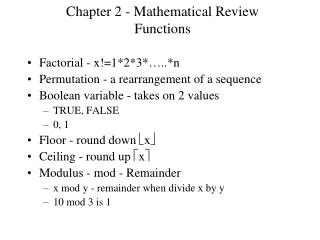
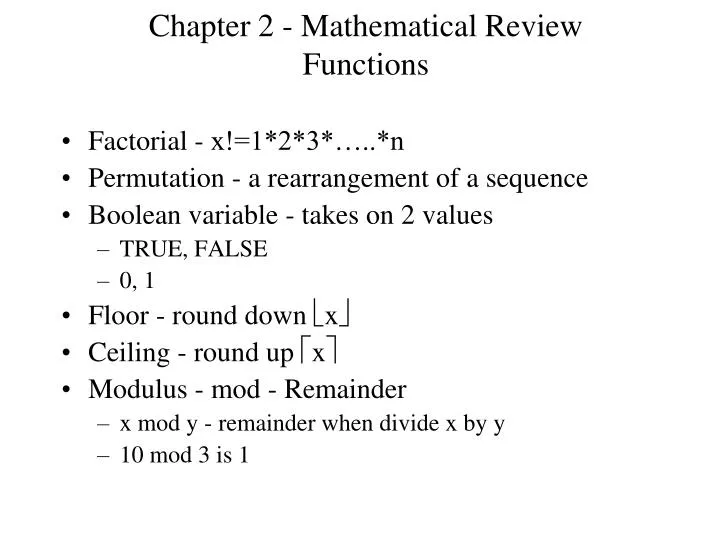
Chapter 2 - Mathematical ReviewFunctions • Factorial - x!=1*2*3*…..*n • Permutation - a rearrangement of a sequence • Boolean variable - takes on 2 values • TRUE, FALSE • 0, 1 • Floor - round down x • Ceiling - round up x • Modulus - mod - Remainder • x mod y - remainder when divide x by y • 10 mod 3 is 1
Logarithms • logby=x bx=y blogby=y • log mn = log m + log n • XAXB=XA+B • log m/n = log m - log n • XA/XB=XA-B • log nr = r log n • (XA)B=XAB • logan=logbn/logba • 2n+2n=2*2n=2n+1
Recursion • A recursive algorithm calls itself. • Must have a base case to stop recursion • Calls must pass a “smaller problem” to the function. This will cause the recursion to eventually stop. • Factorial example: int fact(int n) { if (n<=1) return 1; else return n*fact(n-1) } • Looks a bit like induction • Better to use for’s and while’s when appropriate.
Summations • Adding up a list of values • f(1)+f(2)+f(3)+…+f(n) • if f(i)=i then sum is n(n+1)/2 • if f(i)=i2 then sum is n(n+1)(2n+1)/6 • if f(i)=2i then sum is 2n+1–1 • if f(i)=Ai then sum is (An+1 –1)/(A-1)
Recurrence Relations • Many of our operations (functions) will be recursive. • We will want to analyze the running time for a problem of size n. • Recursion defines this in terms of some work plus the amount of time to solve a smaller problem (using the same algorithm). • A mathematical representation of this time will look like: • T(n) = T(n-1) + 1 • Need the time for the base case • T(1) = 0
Recurrence Relation Solving • Many recurrence relations are solved using the brute force method. Expand it; see the pattern; solve it. • For example: • T(n) = T(n-1)+1 = T(n-1)+1+1 = T(1)+(n-1) = n-1 • Another example: • T(n) = T(n-1)+n; T(1)=1 • T(n) = T(n-1)+n = T(n-2)+(n-1)+n = T(1)+2+…n = 1+2+3…+n = n(n+1)/2
Proof Techniques • Proof by Contradiction • Find a counterexample to prove theorem is false • Assume the opposite of the conclusion is true. Use steps to prove a contradiction (for example 1=2), then the original theorem must be true. • Proof by induction • Show the theorem holds for a base case (n=0 or n=1) • Assume the theorem holds for n=k-1 • Prove the theorem is true for n=k • Example: show 1+2+3+…+n=n(n+1)/2 • for n=1 1=1(2)/2=1 • assume 1+2+3+…+n-1=(n-1)(n)/2; show 1+2+…+n=n(n+1)/2 • (n-1)(n)/2+n=[(n-1)(n)+2n]/2=[n(n-1+2)]/2=n(n+1)/2