How Europe's Geography and Ancient Civilizations Shaped Its Culture and Development
230 likes | 346 Vues
European mountains have profoundly influenced its culture by fostering regional identities and historical significance. Ancient Greece's contributions to democracy, philosophy, and arts have laid the groundwork for modern Western civilization. Furthermore, both Ancient Greece and Ancient Rome shared similarities in governance, architecture, and art that have impacted future societies. During the Middle Ages, Europe experienced significant transformations, such as the rise of feudalism and urbanization, shaping its societal structure. This tutorial explores these aspects of European history.


How Europe's Geography and Ancient Civilizations Shaped Its Culture and Development
E N D
Presentation Transcript
Europe A Peninsula of Peninsulas
Bell-Ringer – 12/3 • In your spiral notebook (p. 4): • How have mountains shaped the culture of Europe? “Mountains have shaped Europe’s culture by _____________________”
Bell-Ringer – 12/4 • In your writing notebook (p. 5) • How has Ancient Greece influenced the modern world? • Ancient Greece has influenced the modern world by _____________
Bell-Ringer 12/5 • In your writing notebook: • How were Ancient Greece and Ancient Rome similar? • “Ancient Greece and Ancient Rome were alike in many ways. For example, _____________”
Bell-Ringer 12/6 • In your writing notebook • Describe a major change in Europe during the Middle Ages. • “Europe had major changes between the beginning and end of the Middle Ages. One of the most important changes was ________________ . What happened was __________________.
How Many Triangles? Answer: 13 Small: 9 Medium: 3 Large: 1
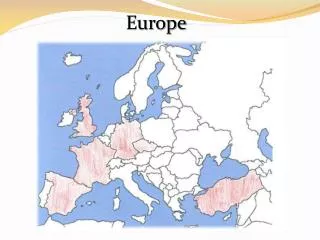
Definition: Peninsula • A body of land surrounded on three sides by water • Example: Florida • Example: Michigan • How many peninsulas?
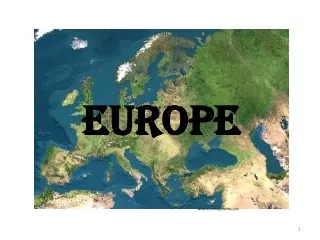
Europe • How many peninsulas?
Major Peninsulas • Italian or Apennine Peninsula • Iberian Peninsula • Balkan Peninsula • Scandinavian Peninsula • Jutland (Denmark) • Europe itself
Effect • No point in Europe is more than a few hundred miles from the ocean (not counting Russia and the former Soviet Union, which is its own unit). • European countries that are landlocked (no ocean access) • Luxembourg • Switzerland • Austria and Hungary (became landlocked after WWI) • Czech Republic and Slovakia (formerly Czechoslovakia) • Liechtenstein • Serbia, Kosovo and Macedonia (formerly part of Yugoslavia) • Andorra • Microstates: Vatican City and San Marino
Trade and Rivers • Landlocked countries were still able to move goods for trade on Europe’s extensive system of navigable rivers. • The Danube River is about 1800 miles long and is Europe’s second-longest river after the Volga River in Russia • It is navigable for almost its entire length and passes through ten countries, including five of the landlocked ones.
The Northeastern Highlands are not good for farming. • The North European Plain stretches from France to Russia. It is excellent farmland. • The Central Uplands has very thin, rocky soil. • The Alps contains many small valleys that are good for farming.
Because of the Gulf Stream, most of Europe has a mild climate. • Southern Europe has a Mediterranean climate. Hot, dry summers with mild winters.