Download
1 / 15
150 likes | 272 Vues
This lecture offers a comprehensive review of QS9000 standards, detailing the automotive adaptations of ISO9000 and its significance in quality management across over 60 countries since 1987. It explains the 20 elements of QS9000, including management processes, design control, and documentation requirements. Additionally, the session covers key concepts in experimentation strategy, highlighting the importance of identifying influencing factors and using statistical methods for effective data analysis. Participants are tasked with documenting job aspects relevant to these standards to enhance understanding.

E N D
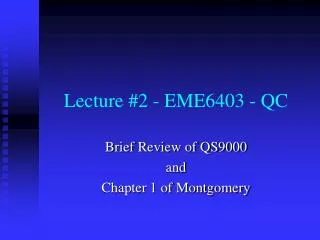
Lecture #2 - EME6403 - QC Brief Review of QS9000 and Chapter 1 of Montgomery
QS 9000 • Automotive Adaptation of ISO9000 • ISO9000 initially written in 1987 • Adopted by over 60 countries • ‘Quality management and quality assurance standards - provides guidelines for the selection and use of the standard’ • To prove you adhere - REGISTRATION!!
QS9000 • Consists of 20 elements of ISO9000 • Divides up the business process • ‘management, quality, contracts, design, document and data control, purchasing, inspection and testing, inspection and test status, control of customer supplied product, prod. ID and traceabilikty, process control, conyrol of inspection/measuring/test equipment, control of nonconforming product, corrective and preventative action, handling, quality records, internal quality audits, training, servicing, statistical techniques
THREE unique Automotive adaptations • Production part approval process • PPAP • Continuous improvement • Manufacturing capabilities
Other versions of 900X • 9001 - Service Organization • 9002 - production and installation • 9003 - inspection and testing • 9004 - Management
What to do?? • Say what you do and do what you say • First of all: DOCUMENT what you do • Second of all: Make sure documentation proves this • External auditors enforce • *read up* on documentation • the document is hefty
The Big Three Document • In order to simplify life and coordinate things, the copied QS9000 document takes each of the 23 elements and explains its documentation further • *quickly review* the document to get a feel for the documentation required by this process
Your homework • You may or may not have been in a QS9000 completed process • In either case, select one element of your job and figure out where it fits [ie. 4.19] • Create a one page item that either: • states what you do and what documents are required to prove this • is the proposed document to follow
Caveats • Typically, the process takes 6-12 months • Your homework should not exceed an hour • Simply document one aspect of your job, or create a document to document your job • If you have already done this and it is in a 3 ring binder …. • Adapt it or do it fresh
CHAPTER 1 - Strategy of Experimentation • A problem is assumed - and inquiring minds want to find out more details • What factors have an influence on this problem • If a factor has an effect, what should we do about it? • How can we do this FAST and CHEAP!
Define Experiment • Your process has a problem • The ‘Experiment’ is the process of intelligently collecting data regarding the problem and cleverly analyzing it • There will be controllable and uncontrollable factors - shades of grey • There are inputs and outputs to the process
Example - Emissions test engineer • the factors that could impact your test results: • type of car • type of catalytic convertor • temp/humidity/etc • operator
Basic Principles • Statistical design of experiment - plan the experiment so your data collected will be cleverly analyzed • Two aspects: • clever planning [Design] • clever implementation
Guidelines for statistical experimentation • Recognition and statement of the problem • Choice of factors, levels, ranges • process knowledge • Selection of response variable [ $$$] • Actual design selection • implementation • analysis • conclusion and results
conclusion - Keep in mind: • use non-statistical knowledge • KISS • recognize the difference between practical and statistical significance • Experiments are INTERATIVE!!! • SECOND HOMEWORK: RULE 1: • Eyeball some statistics from Chapter 2