Update on Perkins V
200 likes | 218 Vues
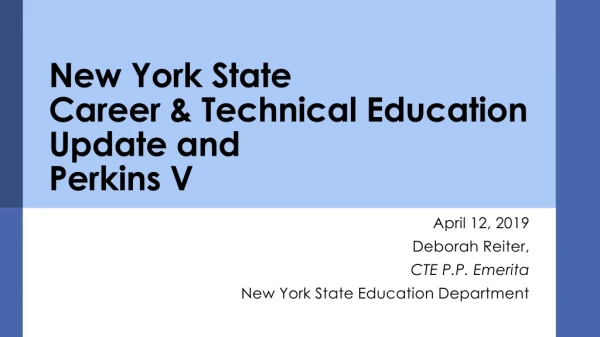
Update on Perkins V. January 28, 2019. CTE Advisory Council. Show-Me Success. Perkins V Overview. Strengthening Career and Technical Education for the 21 st Century Act signed into law by the President on July 31, 2018. New law is being referred to as “Perkins V”


Update on Perkins V
E N D
Presentation Transcript
Update on Perkins V January 28, 2019 CTE Advisory Council
Perkins V Overview • Strengthening Career and Technical Education for the 21st Century Act signed into law by the President on July 31, 2018. • New law is being referred to as “Perkins V” • Goes into effect on July 1, 2019
Perkins V Overview • Year 1 will be a “transition year” • Missouri will submit a one-year transition plan on April 30, 2019 • Full four-year state plan due Spring of 2020
Major Tenets of Perkins V • Maintains focus on CTE program improvement, flexibility, and data/accountability • Programs of Study • Retains state governance structure • Funding formula remains the same
What’s New? • Introduces a comprehensive local needs assessment that requires data-driven decision- making with significant stakeholder consultation and updated every two years (Will not be submitted until Spring 2020) • Changes “local plan” to “local application”
Local Needs Assessment • Performance on federal accountability indicators • Alignment to labor market needs • Size, scope and quality of programs offered • Progress toward implementing programs and programs of study • Recruitment, retention and training of faculty and staff • Progress toward improving access and equity
Local Stakeholders for Consultation • Secondary and postsecondary educators, administrators and other support staff • State or local workforce development boards • Business and industry representatives • Parents and students • Representatives from Special Populations • Agencies serving out-of-school youth, homeless children and youth, at risk youth
What’s New? • Definitions that align Perkins with ESSA and WIOA • Expanded list of stakeholders for state plan development • Spending funds for career exploration in “middle grades” (includes grades 5-8)
What’s New? • Increased focus on serving special populations • Three new categories of special populations students: (1) homeless individuals; (2) youth with parents on active duty in the armed forces; and (3) youth who are in, or have aged out of, the foster care system. • Focus on disaggregation of data
What’s New? • CTE Concentrator definitions: • Secondary – a student who completes at least two courses in a single program or program of study. • Postsecondary – a student who earns 12 credits in a single CTE program or program of study or completes a CTE program if that program encompasses fewer than 12 credits.
Secondary Core Indicators of Performance • Graduation Rate • Academic Proficiency (math, English and science) • Student Placement • Percentage of concentrators in CTE programs leading to nontraditional fields
Secondary Core Indicators of Performance • A measure of “CTE Program Quality” • Student attainment of recognized postsecondary credentials; or • Student attainment of postsecondary credits in their CTE program/program of study; or • Percentage of students participating in work-based learning.
Postsecondary Core Indicators of Performance • Percentage of CTE concentrators who, during the second quarter after program completion, remain enrolled in postsecondary education, advanced training, military service, a serviceprogram, the Peace Corps or are placed or retained in employment.
Postsecondary Core Indicators of Performance • Percentage of CTE concentrators who receive a recognized postsecondary credential during participation in or within one year of program completion. • Percentage of CTE concentrators in CTE programs that lead to nontraditional fields.
Key Decision Points • Secondary Concentrator Definition • Sufficient Size, Scope and Quality • Secondary/Postsecondary Split of Funds • Secondary Quality Indicators • Programs of Study Process Development
Next Steps • Transition Plan Preparation • Education Stakeholder Committee Meeting • Development of Local Needs Assessment
Questions? Dennis D. Harden, Ed.D. Coordinator, Career Education Dennis.harden@dese.mo.gov