
10 likes | 144 Vues
This literature review discusses critical mentoring practices in higher education, emphasizing the need for structured training. Through interviews with mentors, common challenges such as lack of training, mentor role clarity, and relationship management were identified. Sixteen key best practices have been outlined to inform the development of a formal mentoring training program at the University of New Mexico (UNM). The proposed 40-hour curriculum aims to equip mentors with essential skills, improving the effectiveness of mentorship relationships and enhancing educational outcomes for students.
E N D
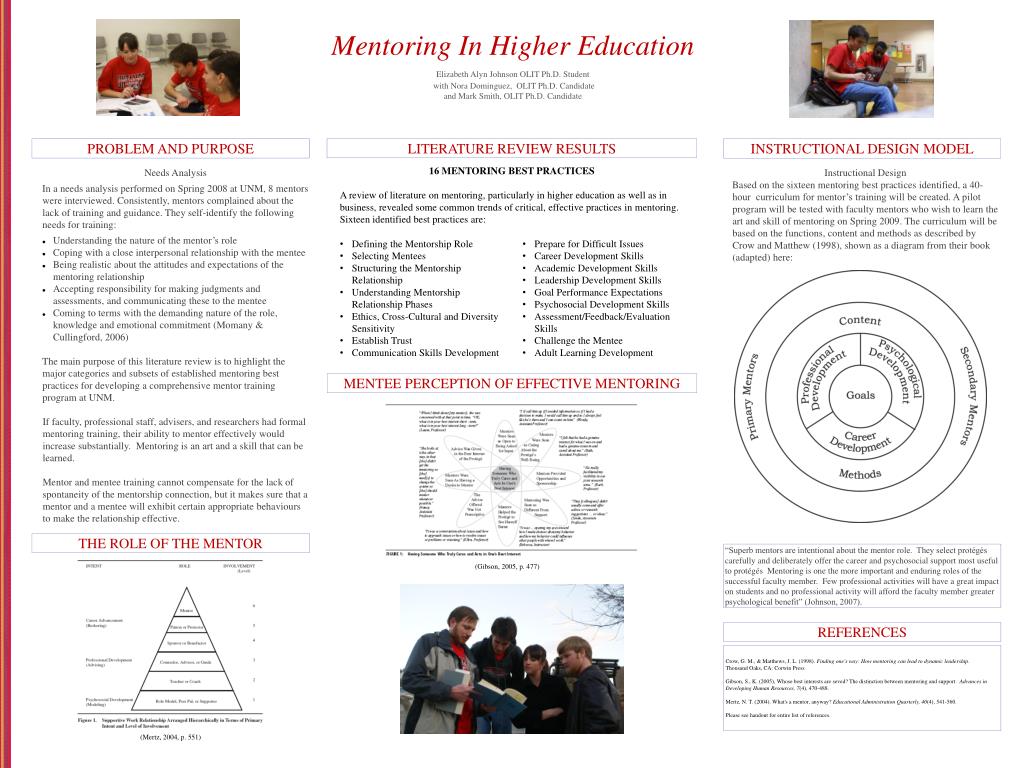
Mentoring In Higher Education Elizabeth Alyn Johnson OLIT Ph.D. Student with Nora Dominguez, OLIT Ph.D. Candidate and Mark Smith, OLIT Ph.D. Candidate PROBLEM AND PURPOSE LITERATURE REVIEW RESULTS INSTRUCTIONALDESIGN MODEL 16 MENTORING BEST PRACTICES A review of literature on mentoring, particularly in higher education as well as in business, revealed some common trends of critical, effective practices in mentoring. Sixteen identified best practices are: Needs Analysis In a needs analysis performed on Spring 2008 at UNM, 8 mentors were interviewed. Consistently, mentors complained about the lack of training and guidance. They self-identify the following needs for training: • Understanding the nature of the mentor’s role • Coping with a close interpersonal relationship with the mentee • Being realistic about the attitudes and expectations of the mentoring relationship • Accepting responsibility for making judgments and assessments, and communicating these to the mentee • Coming to terms with the demanding nature of the role, knowledge and emotional commitment (Momany & Cullingford, 2006) The main purpose of this literature review is to highlight the major categories and subsets of established mentoring best practices for developing a comprehensive mentor training program at UNM. If faculty, professional staff, advisers, and researchers had formal mentoring training, their ability to mentor effectively would increase substantially. Mentoring is an art and a skill that can be learned. Mentor and mentee training cannot compensate for the lack of spontaneity of the mentorship connection, but it makes sure that a mentor and a mentee will exhibit certain appropriate behaviours to make the relationship effective. Instructional Design Based on the sixteen mentoring best practices identified, a 40-hour curriculum for mentor’s training will be created. A pilot program will be tested with faculty mentors who wish to learn the art and skill of mentoring on Spring 2009. The curriculum will be based on the functions, content and methods as described by Crow and Matthew (1998), shown as a diagram from their book (adapted) here: • Defining the Mentorship Role • Selecting Mentees • Structuring the Mentorship Relationship • Understanding Mentorship Relationship Phases • Ethics, Cross-Cultural and Diversity Sensitivity • Establish Trust • Communication Skills Development • Prepare for Difficult Issues • Career Development Skills • Academic Development Skills • Leadership Development Skills • Goal Performance Expectations • Psychosocial Development Skills • Assessment/Feedback/Evaluation Skills • Challenge the Mentee • Adult Learning Development MENTEE PERCEPTION OF EFFECTIVE MENTORING THE ROLE OF THE MENTOR “Superb mentors are intentional about the mentor role. They select protégés carefully and deliberately offer the career and psychosocial support most useful to protégés Mentoring is one the more important and enduring roles of the successful faculty member. Few professional activities will have a great impact on students and no professional activity will afford the faculty member greater psychological benefit” (Johnson, 2007). (Gibson, 2005, p. 477) REFERENCES Crow, G. M., & Matthews, J. L. (1998). Finding one's way: How mentoring can lead to dynamic leadership. Thousand Oaks, CA: Corwin Press Gibson, S., K. (2005), Whose best interests are seved? The distinction between mentoring and support. Advances in Developing Human Resources, 7(4), 470-488. Mertz, N. T. (2004). What's a mentor, anyway? Educational Administration Quarterly, 40(4), 541-560. Please see handout for entire list of references. (Mertz, 2004, p. 551)