Exploring the 4th Amendment: Search, Seizure, and Privacy in California v. Greenwood Case
Dive deep into the 4th Amendment's implications through the landmark case California v. Greenwood. In this lesson, students will analyze the concepts of search, seizure, and privacy, exploring whether a warrantless search of someone's trash constitutes an unreasonable search. Through discussion and writing exercises, students will engage with both the majority and dissenting opinions of the Supreme Court, examining the relationship between personal privacy and public accessibility. Essential questions will guide their understanding of constitutional principles and their significance in contemporary legal contexts.

Exploring the 4th Amendment: Search, Seizure, and Privacy in California v. Greenwood Case
E N D
Presentation Transcript
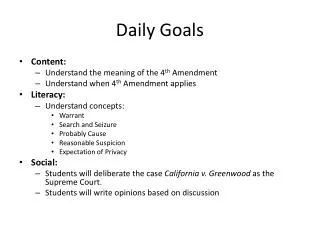
Daily Goals • Content: • Understand the meaning of the 4th Amendment • Understand when 4th Amendment applies • Literacy: • Understand concepts: • Warrant • Search and Seizure • Probably Cause • Reasonable Suspicion • Expectation of Privacy • Social: • Students will deliberate the case California v. Greenwood as the Supreme Court. • Students will write opinions based on discussion
California v. Greenwood FindingMajority Opinion • Question: Does a warrantless search of someone’s trash can constitute an unreasonable search and seizure? • It is a reasonable search and seizure. • Why? The public does not reasonably expect their garbage to be private: • Trash is accessible to animals, children, scavengers, and snoops. So why not police? • The public expects the trash to be handled by a third party (garbage man). • It’s out on the curb, which is a public place away from the private home.
California v. Greenwood FindingDissenting Opinion • Question: Does a warrantless search of someone’s trash can constitute an unreasonable search and seizure? • Yes it does. People throw away very personal things. The public finds it uncivilized to sift someone’s trash to find out stuff about them. Go get a warrant if you want to search! • Containers are sealed and trash bags are opaque. The reason is people expect privacy. • People are protected from warrantless searches and seizures in their “personal effects.” Even if they are being transported to the landfill. • Riffling through someone’s bedroom can reveal intimate details about hygiene and sexual practices. • Riffling through someone’s desk draws can disclose private financial information, private thoughts, and other secrets. How is trash different?
Discussion Questions • What language of the Constitution and the amendments, other law, or previous cases was relied upon in the Court’s decision? • What were the key principles involved? • What was the significance of the court’s decision? • Did the decision change the meaning of the Constitution? • Can you predict problems arising out of the court’s decision? • If you agreed with the Court’s decision, did you use the same reasoning? • If you disagreed with the Court’s decision, did you agree with the dissent’s reasoning? • What, if anything, should happen next?
Discussion Questions • What language of the Constitution and the amendments, other law, or previous cases was relied upon in the Court’s decision? • What were the key principles involved? • What was the significance of the court’s decision? • Did the decision change the meaning of the Constitution? • Can you predict problems arising out of the court’s decision? • If you agreed with the Court’s decision, did you use the same reasoning? • If you disagreed with the Court’s decision, did you agree with the dissent’s reasoning? • What, if anything, should happen next?