Optimizing Real-Time Computing with User-Space Techniques and Kernel Isolation
This document explores the challenges of achieving low-latency, real-time performance in general-purpose operating systems like Linux. It discusses methods to mitigate unpredictability by isolating critical processes from kernel interruptions, emphasizing user-space functionality to enhance response times. Techniques such as memory mapping of hardware, direct interrupt handling, and using shared memory for inter-process communication are detailed. Furthermore, the advantages of non-preemptive mutexes and efficient context switching methods are highlighted to improve system responsiveness in time-sensitive applications.

Optimizing Real-Time Computing with User-Space Techniques and Kernel Isolation
E N D
Presentation Transcript
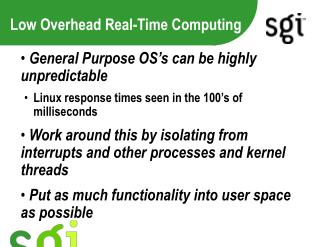
Low Overhead Real-Time Computing • General Purpose OS’s can be highly unpredictable • Linux response times seen in the 100’s of milliseconds • Work around this by isolating from interrupts and other processes and kernel threads • Put as much functionality into user space as possible
User Space Functionality • Memory map hardware and clocks, and handle interrupts in user space • Use shared memory for IPC • Memory map special kernel pages or use virtual system calls • Do uncontended locking with IRIX usyncs or Linux futuxes
Overview • - General Purpose OS’s are complicated and unpredictable • - Good RT performance may be had by protecting cpu’s from outside interference • - User level interfaces to common features further reduce latency and unpredictability • - Summary: Lock out and avoid as much of the kernel as possible
Methods of Blocking Interruptions • - Restrict cpu’s to specific threads • - Isolate cpu’s from TLB and cache invalidations • - Direct hardware interrupts elsewhere • - Turn off the timeshare scheduling interrupt • - Ward off any remaining kernel background tasks
Lock in User Space When Possible • - IRIX usyncs and Linux futexes attempt to handle most locking actions with atomic primitives outside the kernel • - Contended locks force accessors into the kernel to use wait queues • - Usually just costs a few instructions vs entering and leaving the kernel for a free lock
SGI IRIX Non-preemptive Mutexes • - Priority Inheritance and Priority Ceiling both have overhead even with uncontended locks • - IRIX non-preemptive mutexes provide pseudo - priority ceiling protection by preventing a lock holder from being preempted by any other thread • - Lock holders are required to yield the cpu if they prevented an actual preemption attempt • - The two varieties of non-preemptive mutexes protect against other pthreads in the same process and against any threads in the system
Provide Direct Access to Hardware • - Memory map or allow programmed I/O access to hardware features • - Example: mmap() the Real-Time Clock • - 380ns clock_gettime() vs 2.4us from the kernel • - Example: mmap() a PCI device • - full register level access from user space
User Level Interrupts • - Handle hardware interrupts in user space asynchronously • - Works great with memory mapped hardware • - 31.2us to wake a waiting user thread • - 13.6us to handle with a User Level Interrupt
Direct I/O • - Bypass the buffer cache by directly writing to and reading from user space to disk • - Eliminates memory copies and kernel overhead • - Allows the process to implement its own caching algorithm
Inter Process Communication • - Place message queues in shared memory areas • - 2.9us to enqueue a message in shared memory • - 6.7us to enqueue a message through the kernel
Memory Map the Kernel • - Provide useful per-thread data in special mapped pages of kernel memory • - Provides quick access to the current cpu ID, and scheduling and timing information • - Provides a window for the thread to indicate its signal mask and scheduling hints without entering the kernel
Context Switches • - Some pthread implementations map multiple pthreads onto the same kernel thread • - Some things like signals become difficult but the benefit is that the kernel is less involved • - Many to one mapped pthreads can context switch in 1.6us vs 27.2us for one to one