Cell Biology
This guide provides an overview of the two main types of cells: prokaryotic and eukaryotic. Prokaryotic cells are the simplest and most abundant, lacking a nucleus and organelles except for ribosomes. In contrast, eukaryotic cells are larger and contain organelles and a nucleus, forming the basis for animals, plants, fungi, and protists. The guide also explores the unique characteristics of animal and plant cells, highlighting specialized organelles such as chloroplasts, lysosomes, and the cell wall. Understanding these components is essential for studying biology and cell functions.

Cell Biology
E N D
Presentation Transcript
Cell Biology Cells and Organelles
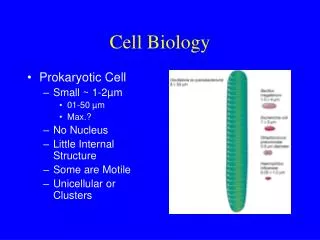
Two Types of Cells • Prokaryotic Cells • Simplest and most abundant cells on Earth • Contain no nucleus or organelles (except ribosomes) • All bacteria are prokaryotes • Eukaryotic Cells • Larger than prokaryotic cells • Contain organelles and a nucleus • Make up animals, plants, fungi and protists
Eukaryotic Cells: Animal vs Plant • Animal Cells • Circular shape • Have lysosomes and centrioles that plants do not • Have several small vacuoles • Plant Cells • Square shape • Have chloroplasts and a cell wall that animals do not • Have a large central vacuole
Cell Organelles • Organelles are membrane bound structures that perform special functions within the cell. • Each organelle performs a specific task that contributes to the homeostasis of the cell
Organelles – A Closer Look • Nucleus - contains the genetic information of the cell (DNA) - control center of the cell - surrounded by a double layered porous membrane called the nuclear membrane (or envelope)
Nucleus continued Chromatin: material consisting of DNA and proteins; visible as individual chromosomes in a dividing cell Nucleolus: non-membranous organelle involved in production of ribosomes; a nucleus has one or more nucleoli
2. Cell Membrane (also called plasma membrane) - Encloses the cell contents and separates them from the outside - Layer between the inside and outside of the cell - Selectively permeable
3.Cytoplasm - jelly – like substance that fills the cell and supports the other organelles 4. Endoplasmic Reticulum (ER) - transfers materials to different parts of the cell - active in membrane synthesis - rough (ribosome studded) and smooth
5. Ribosomes - synthesize proteins - found on the endoplasmic reticulum - composed of two sub units. 6. Mitochondria - the “powerhouse” of the cell - makes energy
7. Golgi Body - also called Golgi Apparatus - packages material inside the cell and transfers it out.
8. Centrosome • Region where the cell’s microtubules are initiated • In an animal cell, contains a pair of centrioles
9. Vacuoles - “storehouses” - contain food, water, waste or cell material - In plant cells, there is only one central vacuole
PLANT CELLS ONLY 10. Chloroplast - performs photosynthesis to produce food for the cell - sunlight energy gets converted into chemical energy stored in sugar molecules
PLANT CELLS ONLY 11. Cell Wall - made of cellulose, proteins and other polysaccharides - rigid outer membrane that gives structure and support
ANIMAL CELLS ONLY 12. Lysosomes - breakdown food and digest wastes and old cell parts
ANIMAL CELLS ONLY 13. Flagellum • movement organelle present in only some animal cells • composed of microtubules 14. Microvilli • Projections that increase the cell’s surface area