Understanding Infeasible Linear Programming Solutions and Two-Phase Method
This document explores the challenges of infeasible linear programming solutions, focusing on maximizing the objective function z = 3x1 + 2x2 under given constraints. It details the Two-Phase Method, including the first phase aimed at minimizing a surplus variable R. The analysis identifies critical points such as entering and leaving variables, the significance of pseudo-optimal solutions, and the absence of feasible solutions. It emphasizes the importance of recognizing when constraints prevent optimality, enhancing understanding of linear programming difficulties.

Understanding Infeasible Linear Programming Solutions and Two-Phase Method
E N D
Presentation Transcript
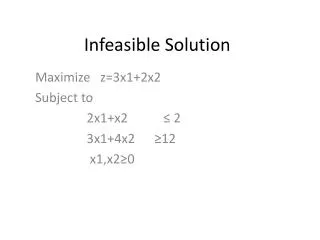
Infeasible Solution Maximize z=3x1+2x2 Subject to 2x1+x2 ≤ 2 3x1+4x2 ≥12 x1,x2≥0
Max z=x1+2x2-MR 2x1+x2 +x3 =2 3x1+4x2 -x4+R=12 x1,x2,x3,x4,R≥0
Pseudo-optimum The table is pseudo-optimum because R=4 which is not zero. There is no feasible solution exist
Constraint 2 Constraint 1
Two-Phase Method Phase-1 Min z=R1 S.T. 2x1+x2 +x3 =2 3x1+4x2 -x4+R=12 x1,x2,x3,x4,R≥0