The simplex method for infeasible solution
160 likes | 266 Vues
Learn the simplex method applied to an infeasible system of linear equations to identify contradictions and proof techniques. Understand pivoting, pivoting invariants, and terminal conditions.


The simplex method for infeasible solution
E N D
Presentation Transcript
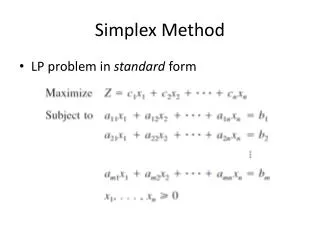
Example -x1-2x2+3x3<=3; -2x1-6x2+x5>=9; 3x1-x2-7x5>=2; x1+5x2+4x4>=5; x2-3x3>=6; slack variablesartificial variables x1 x2 x3 x4 x5s1 s2 s3 s4 s5y1 y2 y3 y4 y5b Min Σ yi ≠ 0 → infeasible
For convenience: ......(1)
First pivoting(i) Suppose is chosen as pivot Eliminate from (1) by substitution: (*)
First pivoting(ii) Eliminate from other rows by substitution: g ≠ i
First pivoting(iii) (1)= Sum of each rows = sum of those rows not containing pivot Proof:
First pivoting(iv) Similarly,
Pivoting invariant(i) The last row = -1* (sum of those rows not containing any pivot) Proof:
Terminal condition and infeasibility When simplex method terminates, the last row (equation) must be of the form: where It’s a contradiction!!
UNSAT proof Ex: 768*(-2x1-6x2+x5>=9) 512*(3x1-x2-7x5>=2) -5120x2-2816x5>=7936 768*(x2-3x3>=6) -4352x2-2304x3-2816x5>=12544 4352*(X2>=0) -2304x3-2816x5>=12544 2304*(X3>=0) 2816*(X5>=0) -2816x5>=12544 0>=12544