Download
1 / 8
80 likes | 198 Vues
Discover the essential vocabulary and concepts of Ancient China, including the Oracle, Legalism, and the Silk Road. Learn about significant historical figures like Confucius and Laozi, and their contributions to Chinese philosophy. Explore the engineering marvels such as the Great Wall and the Three Gorges Dam, and understand the impacts of geographical challenges and internal conflicts during the Warring States Period. This overview highlights the advancements that shaped Chinese civilization, promoting trade, culture, and societal structure.

E N D
嗨 hi in Chinese Alex Mork and Connor Maguire Unit 11Ancient China
Vocabulary • Oracle- a prediction by a wise person • Legalism- the belief that people are bad by nature and need to be controlled • Silk road- a network of trade routes that stretch from China to the Mediterranean • The Great Wall- a barrier made of walls across China’s Northern frontier • Diffusion- the spread of ideas from one culture to another
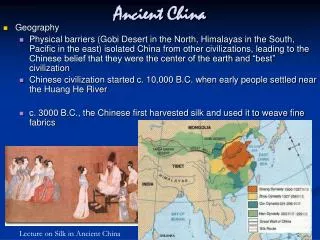
Geography • Huang He river (yellow river)- a river that flows from the Kunlun mountain, to the yellow sea • Chang Jiang(Yangtze)- longest river in Asia • 3 Gorges Dam- a barrier made on the Yangtze to control floods • Great wall- a barrier of walls on China’s Northern frontier • Silk Road- a network of trade routes that stretch from China to the Mediterranean. • Human impact on civilization- creating walls, roads, cities, and dams to better the environment for the life of humans
Leaders & Important People • Confucius- his role was to create a philosophy that the leader would believe. Created Confucianism. • Laozi- his role was to teach Daoism. Created the basic text of Daoism. • Shi Huangdi- first emperor of the Qin dynasty. Created a strong government with strict laws and punishments.
Contributions Of Civilization • The Chinese had many great inventions like gunpowder, compass, paper, ink, printing, seismometer, and matches. • These inventions helped them gain money, population, improve trade, and overall make the civilization better.
Conflict • The Chinese were either battling themselves or the Huns at this time. • They fought themselves because the states wanted more power in the civilization. • The time period in which the Chinese fought against themselves was called the Warring States Period. • The Huns wanted more land so they tried to conquer China.
Conflict Continued • Geographic struggles when the river flooded which was very often. • When the river flooded people were often pushed together to try and find safe land. • Eventually the Three Gorges Dam was built to protect them.