Effective Strategies for Capturing Requirements Quickly and Efficiently
Discover practical tips and techniques from David Greene, PMP, consultant and project manager, on how to capture project requirements swiftly and effectively. With a focus on "semi-agile" workshops and methods, this guide covers preparation, stakeholder engagement, and diverse ways to gather requirements through observation, interviews, and document reviews. Learn the importance of granularity in requirements, how to adapt your approach based on project complexity, and actionable ideas for improving your requirements capture process to meet tight deadlines.

Effective Strategies for Capturing Requirements Quickly and Efficiently
E N D
Presentation Transcript
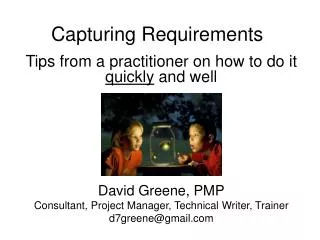
Capturing Requirements Tips from a practitioner on how to do it quickly and well David Greene, PMP Consultant, Project Manager, Technical Writer, Trainer d7greene@gmail.com
A shrinking time frame to capture requirements Weeks/Months 1 Day • Medium & small • RAD projects • Custom SW (collaboration apps) • Led 100+ require-ments workshops • Large traditional projects • Order admin • Waste treatment plant • Military maintenance & logistics • Health insurance
Capturing requirements • How UML came to be • How to think about requirements • Ways to capture • Before you capture • What you can capture • What you should capture • Facilitated “semi-agile” workshops • Compare to “fully agile” workshops • Questions for your BA/facilitator • Answers for skeptics • Ideas for action
1. UML: “modeling, not “markup” 1980s 1990s. Analysis & design diagrams for communication: e.g. “use cases” and “activity diagrams.”
2. Collections of requirements are likemaps By definition, they are incomplete and inaccurate. They will change. They will be mis-interpreted. • The ones you need depend on: • your situation, • your goals and • what you know.
3. Many ways to capture requirements 1. Review documents (Often overlooked. Always use.) 2. Observe users (try video) 3. Be a user 4. Interview (combine with a survey to save $) 5. Survey / questionnaire 6. Facilitate a workshop (esp. for x-functional groups, groups with unresolved differences, or speed) 7. Brainstorm 8. Prototype (try free online “wireframe” (screen mockup) tool: goMockingbird.com) 9. Modify an existing system (can cut scope of requirements effort)
4. Before you capture • Prepare • Prepare • Prepare
6. Requirements you should capture. • Coarse granularity: Be “complete”. • Medium granularity: Capture more detail if: • Complex • High risk • Problematic • Expensive • New • Fine granularity: Know when to stop. Get enough & no more.
7a. Prep for 1-day facilitated workshop (“semi-agile”) -2 or 3 weeks Con call to discuss: • Agenda and deliverables • Who should attend (6-10 people) • Other stakeholders • Room set-up • Give & get homework: questionnaire, forms (ask for them filled in, not blank), reports, 10Ks, …) - 1 week Do homework
7b. Intro to 1-day workshop • Purpose/goals of workshop • Rules (start-end on time, meeting etiquette, roles, ways to deal with conflict, open issues list,) • Introductions (5 or 10-minute ice-breaker if desired): • *Review summary of business context • *Restate goals/objectives of project • *Review assumptions & constraints • Technical platforms • Legal/contractual requirements • *Review scale (of org, problem domain, project) *Obtained during pre-workshop prep
7c. Heart of a 1-day workshop “Problem domain” • Weaknesses of current system • Write down • Scrub • Cause-and-effect • Data • Processes • Other Requirements • List categories • Write down requirements • Scrub • Group • Prioritize “Problem domain” • Weaknesses of current system • Write down • Scrub • Cause-and-effect • Data • Processes • Other Requirements • List categories • Write down • Scrub • Group • Prioritize
7d. End of day & post-workshop Take workshop ½ step beyond requirements • Preliminary product design & project planning • “Value map” of modules (requirement bundles) • Wrap-up • Recap • Assign open issues • Next steps AFTER THE WORKSHOP • Document requirements & scrub
8. Compare to “fully agile” requirements workshop • Get a big open room • Draw lots of pictures • Writes lots of stories • Brainstorm everything else • Scrub the list and make it shine The Agile Samurai by Jonathan Rassmussen Note: “Inception deck” a fast way to create a solid project charter.
9. Questions for your BA/facilitator • Can you explain your requirements approach and show some examples? • Which aspect of this project needs the most attention? • How will you adjust your approach to fit this project? • What preparation should you and I do? Note to clients: Don’t blindside your BA/facilitator.
10. Answers for skeptics • Agile is a fad • We don’t need a facilitator. • Workshops too “touchy-feely” • Doesn’t fit large projects. • Doesn’t fit government projects
11. Ideas for action • Get started on faster/leaner requirements • Change the mix of methods you use. • Try templates for ideas (FURPS+ or Volere) • Develop criteria for requirements & scrub them. • Enlist users to do preliminary design (screen mockups w.goMockingbird.com). • Use “Inception deck” to create your next project charter. • If you want to experiment with agile at low risk: • Start with a small/medium internal project • Try a structured semi-agile requirements workshop (as transition to a “self-managed” fully agile one).
Question time David Greene, PMP Consultant, Project Manager, Technical Writer, Trainer d7greene@gmail.com