Download
1 / 8
80 likes | 213 Vues
This guide explains the concept of proportions, illustrating how to determine if two ratios are equivalent using cross products. It covers the basics of proportions, including the property that states the cross products of a proportion are equal. Moreover, it provides real-world examples, such as predicting preferences based on surveys, to highlight practical applications. Whether you're solving for an unknown in a proportion or making predictions, this overview offers clear instructions and the foundational knowledge necessary for effective problem-solving.

E N D
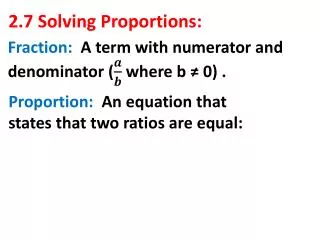
proportion- • Words: an equation that shows that two ratios are equivalent • Symbols: = , b 0, d 0
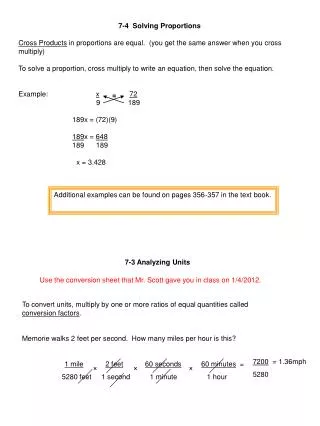
One way to determine whether two ratios form a proportion is to find their cross products. If the cross products of two ratios are equal, then the ratios form a proportion. 18 18 =
Property of Proportions • Words: the cross products of a proportion are equal • Symbols: If then ad = bc. = ,
If one value in a proportion is unknown, you can use equivalent fractions to solve the proportion. x 6 z 30 = = x 6
You can use proportions to make predictions. 8 out of 10 dentists prefer Crest. There are 150 dentists in a certain city. Predict how many of them prefer Crest. x 15 prefer Crest prefer Crest = x 15 total total d 120 prefer crest =
According to the results of a survey, 27 out of 50 people exercise regularly. Suppose there are 2600 people in a community. How many of these people can be expected to exercise regularly. exercise regularly exercise regularly x 52 = x 52 total total p 1,404 people =
If one value in a proportion is unknown, you can use cross products to solve the proportion. 4 z 10 2 = = 4z 20 = z 20 4 = z = 5