Download
1 / 26
260 likes | 384 Vues
Dive into the fascinating world of waves! This lesson covers mechanical and electromagnetic waves, exploring their interactions such as reflection, refraction, diffraction, and absorption. Students will engage in hands-on activities to illustrate these concepts and their real-world applications. You'll learn about constructive and destructive interference through examples and visual illustrations, strengthening your understanding of wave behavior. Let's uncover how waves interact, blend, and travel through different mediums, and their impact on sound and light!

E N D
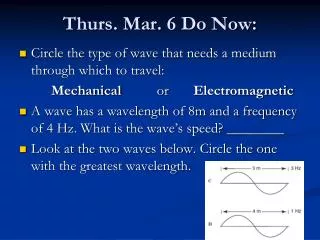
Thurs. Mar. 6 Do Now: • Circle the type of wave that needs a medium through which to travel: Mechanical or Electromagnetic • A wave has a wavelength of 8m and a frequency of 4 Hz. What is the wave’s speed? ________ • Look at the two waves below. Circle the one with the greatest wavelength.
Learning Goals: • Students will be able to – • Explain the 4 ways in which waves interact • Illustrate the 4 types of wave interactions and provide examples of each
Activity: • You are going to investigate the different ways that waves interact with one another. • Each person needs to fill out a chart based about the 4 types of interactions: • Refraction • Reflection • Diffraction • Absorption
Reflection • When waves strike an object and bounce off of it • Examples • Mirror • Echos
Refraction • A wave travels from one medium to another so it changes speed and bends • Examples • Things under water • Prisms bending white light into colors
Diffraction • Waves bend around a barrier • Examples • Waves bend around rocks in the ocean
Absorption • Waves can be absorbed as they pass through objects • Amplitude gets smaller as it passes through material • Example: • Sponge absorbing water waves • Sunglasses have dark light that absorbs light
Activity Continued: • Once your chart is filled in you need to find your group and receive your assigned interaction • Your group will make a poster about the interaction including • Definition • Illustration • Examples
Do Now: • What do you think happens when two waves bump into each other? • Do you think a wave can stand still?
Learning Goals: • Students will be able to – • Define constructive and destructive interference • Classify standing waves, interference and wave behaviors in examples
Label the Wave Behavior: A: ____________________ B: ____________________
Label the Wave Behavior: C: ____________________ D: ____________________
Wave Interference • Two or more waves overlap and combine to form a new wave
Examples of Interference: • http://id.mind.net/~zona/mstm/physics/waves/interference/waveInterference2/WaveInterference2.html
Constructive Interference • When does it happen? • When waves are on the same side and add together • Same side = in phase • Crest adds to another crest • What happens to the amplitude? • Becomes larger
Destructive Interference • When does it happen? • Waves on opposite sides add together • Opposite sides = out of phase • Crest and trough meet • What happens to the amplitude? • Becomes smaller
Interference Constructive Destructive
Example – Sound Interference: • The sound from two speakers meeting and amplifying the sound is an example of _______________________ interference. • The sound from two speakers meeting and canceling out is an example of _________________________ interference.
Example – Light Interference: • The light from two sources meeting and amplifying the light is an example of ___________________ interference. • The light from two sources meeting and canceling each other out is an example of __________________ interference.
Standing Waves: • Occurs when a wave is trapped in one spot between boundaries
Practice on Your Own: • Complete the practice portion of today’s packet with a partner


![Prof. Chris Carothers Computer Science Department Lally 306 [Office Hrs: Wed, 11a.m – 1p.m]](https://cdn2.slideserve.com/4071720/slide1-dt.jpg)