Understanding Essential Nutrients: Carbohydrates, Fats, Proteins, Vitamins, Minerals, and Water
100 likes | 220 Vues
Learn about the essential nutrients our bodies need to function optimally. This guide covers carbohydrates, fats, proteins, vitamins, minerals, and water—detailing their types, sources, and health impacts. Carbohydrates provide energy but can lead to hunger; fats build body tissue, with healthy and unhealthy types; proteins are crucial for tissue maintenance; vitamins and minerals support growth and health; water is vital for hydration and muscle tone. Equip yourself with knowledge for a balanced diet!


Understanding Essential Nutrients: Carbohydrates, Fats, Proteins, Vitamins, Minerals, and Water
E N D
Presentation Transcript
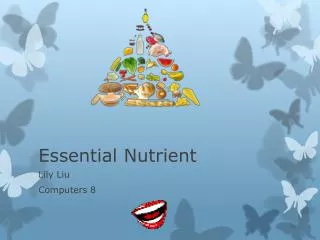
Essential Nutrient Lily Liu Computers 8
Carbohydrate(carb) • Provides energy • Types: simple carb(sugar) complex carb(starches) • Form glucose when digested • Likely to feel hungry again • Found in grains, vegetables, fruits, etc.
Fats • Builds body tissue • Types: Unsaturated fat(good for health) Saturated fat(causes heart disease) Trans fat(found in margarine) • Should take 67 grams(600 calories) of fat • Too much fats causes diseases and cancer • From dairy, meat, vegetable oil, etc.
Protein • Builds, maintains, and replaces tissue in body • Types: Animal protein(contains all amino acid) Plant protein(contains some amino acid) • Made of amino acids • Should take 15% daily • From meat, dairy, vegetables, grains, etc.
Fibre • Helps digestive system to function • Types: Insoluble fibre(doesn’t dissolve in water) Soluble fibre(dissolves in water) • The not fully digested part • Controls appetite • From grains, vegetables, fruits, etc.
Vitamins • Develop body to grow • Types: Fat-soluble Vitamin(stored in body) Water-soluble Vitamin(can’t be stored) • Plenty of foods naturally contain vitamins • Can’t be eliminated after taken too much • From meat, grains, vegetables, sugary foods, etc.
Minerals • Helps body to develop and stay healthy • Types: Macro minerals(body needs a lot) Trace minerals(body needs some) • Helps vitamins to work • Lack of minerals leads to health problems • From vegetables, dairy, meat, fruits, etc.
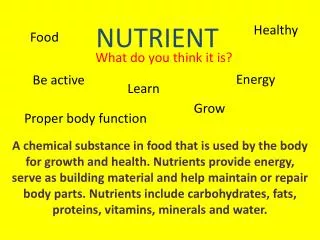
Water • Keeps cells and body functions in work • Improves muscle tone • 60% of body weight is water • In all the systems in body • From food, drinks, metabolism, etc.
Bibliography • http://www.netdoctor.co.uk/focus/nutrition/facts/lifestylemanagement/carbohydrates.htm • http://kidshealth.org/kid/stay_healthy/food/carb.html# • http://www.netdoctor.co.uk/focus/nutrition/facts/lifestylemanagement/fats.htm • http://kidshealth.org/kid/nutrition/food/fat.html# • http://www.netdoctor.co.uk/focus/nutrition/facts/detoxification/dietaryprotein.htm • http://kidshealth.org/kid/nutrition/food/protein.html# • http://www.netdoctor.co.uk/focus/nutrition/facts/lifestylemanagement/fibre.htm • http://www.healthlinkalberta.ca/Topic.asp?GUID=%7B3E8F41E5-D9F6-439A-BEDF-A73CEA1646B3%7D • http://www.netdoctor.co.uk/focus/nutrition/facts/vitamins_minerals/vitamin.htm • http://kidshealth.org/kid/stay_healthy/food/vitamin.html# • http://kidshealth.org/kid/stay_healthy/food/minerals.html# • http://www.netdoctor.co.uk/health_advice/facts/vitamins.htm • http://kidshealth.org/kid/stay_healthy/food/water.html • http://weightloss.about.com/library/blwater.htm