

SlideServe
Menu
Préférences
© SlideServe · v2026

Nuclear Fusion

gazit avatar
10 diapositives · 1.8K Views · Jul 28, 2014

Nuclear Fusion. Process during which two or more atomic nuclei merge and form one heavier nucleus Causes the release or absorption of large quantities of energy Fuels the sun and stars Used to make hydrogen bombs
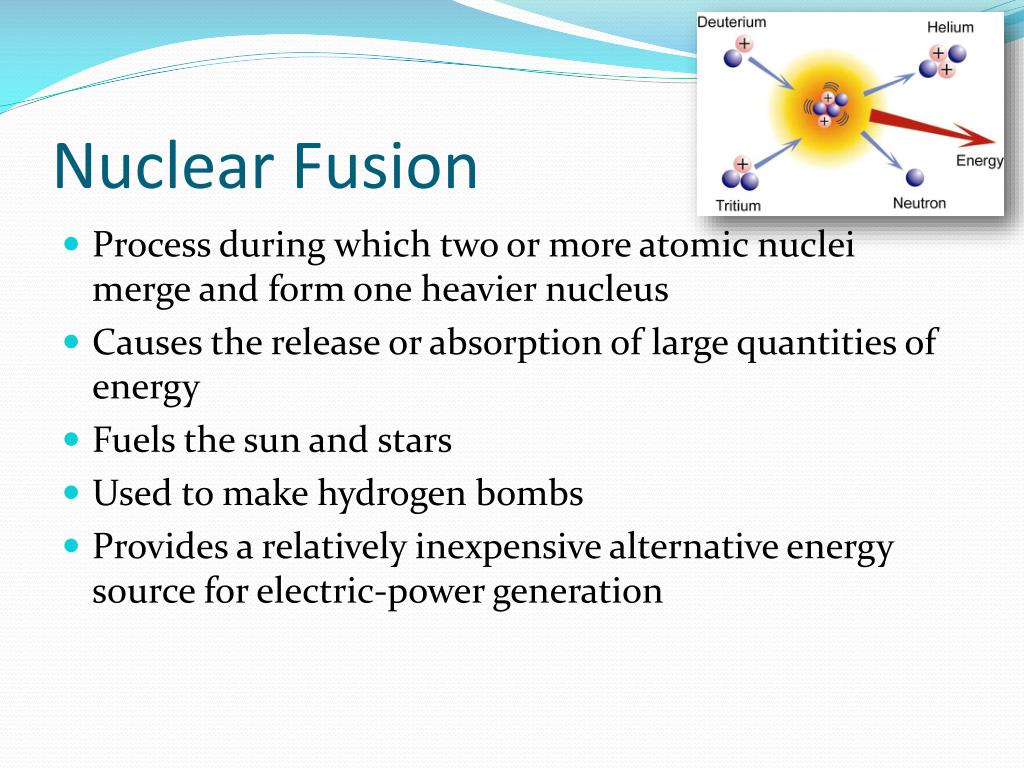
Nuclear Fusion - slide 1
01 / 10Nuclear Fusion
1 / 17

Télécharger la présentation

Nuclear Fusion
Une image / un lien ci-dessous est fourni (tel quel) pour télécharger la présentation

Politique de téléchargement : le contenu du site vous est fourni TEL QUEL pour votre information et votre usage personnel ; il ne peut être vendu, concédé sous licence ni partagé sur d’autres sites sans l’accord de son auteur.Le contenu vous est fourni TEL QUEL, pour votre information et votre usage personnel uniquement. Téléchargez la présentation en cliquant sur ce lien. Lors du téléchargement, si vous ne parvenez pas à télécharger une présentation, l’éditeur a peut-être supprimé le fichier de son serveur.Pendant le téléchargement, si vous ne parvenez pas à obtenir une présentation, le fichier a peut-être été supprimé par l’éditeur.

F I N

Plus de contenu associé

Transcription de la présentation
  1. Nuclear Fusion • Process during which two or more atomic nuclei merge and form one heavier nucleus • Causes the release or absorption of large quantities of energy • Fuels the sun and stars • Used to make hydrogen bombs • Provides a relatively inexpensive alternative energy source for electric-power generation

  2. Nuclear Fission • Nuclear reaction that splits the nucleus of an atom into smaller, subatomic particles • Sum of masses of fragments is less than original mass • Releases large amounts of energy as electromagnetic and kinetic energy • Can occur without neutron bombardment (radioactive decay) • Can be used to create a nuclear chain reaction – exponential growth

  3. Radioactivity • Emission of energetic particles or waves from atoms • Measured in rads, where one rad represents 0.01 joule of energy absorbed per kilogram of tissue • Observed in the heavy elements, like uranium, and unstable isotopes, like carbon-14 • Three distinct types of radiation – alpha particles (positively charged), beta particles (negatively charged), and gamma rays (neutral) • Physically impossible to predict whether or not a given atomic nucleus will decay and emit radiation at any given moment

  4. Advantages of Nuclear Power • Almost no emissions – no pollution into atmosphere • Very Productive – small amount of nuclear power generates large amount of energy • Can be sited almost anywhere (unlike oil which is mostly imported) • New reactor types designed to be physically impossible to melt-down

  5. Disadvantages of Nuclear Power • Expensive to build nuclear plant • Waste products are highly dangerous – melt-down would pose safety hazard to people and surroundings • Expensive to clean up spillages • Products from reactors can be stolen and turned into atomic weapons

  6. How Radiation is Transmitted • Travels in the form of waves or high-speed particles • Through the air  our noses or mouths (breathing) • Through rain  groundwater (lakes and reservoirs)  drinking water • Through water used to cool off nuclear plants  ocean  marine life (e.g. fish)  food

  7. Harmful Effects of Radiation • Hair loss; dry and itchy scalp • Brain damage – seizures and immediate death • Reduction in lymphocyte presence in blood – mild radiation sickness (more susceptible to infection) • Damage to gastrointestinal tract – nausea, bloody vomiting, abdominal pain and diarrhoea • Destruction of the reproductive tract – radiation sterility; birth defects

  8. Half-life • Time taken for half of the atoms in a given mass to decay • Equation for half-life: τ = o.693/λ

  9. Advice on Radioactivity • Keep a safe distance away from places that have the radioactivity symbol • Eat healthy, iodine-rich foods e.g. sea vegetables, yogurt, fish, shrimp, eggs, and strawberries • Take potassium iodide pills in recommended doses if necessary

  10. http://www.atomicarchive.com/Fusion/Fusion1.shtml http://www.universetoday.com/76609/nuclear-fusion/ http://www.atomicarchive.com/Fission/Fission1.shtml http://www.universetoday.com/73600/what-is-nuclear-fission/ http://www.whatisnuclear.com/articles/radioactivity.html http://www.wisegeek.com/what-is-radioactivity.htm http://wiki.answers.com/Q/What_are_advantages_and_disadvantages_of_nuclear_power http://www.nlm.nih.gov/medlineplus/radiationexposure.html http://knowledge.allianz.com/?1436/how-does-radiation-travel http://www.ehow.com/about_5315898_harmful-effects-radiation.html http://www.ndt-ed.org/EducationResources/HighSchool/Radiography/halflife1.htm www.phys.utk.edu/labs/modphys/RadioactiveHalflife.pdf http://www.psychology-advice.net/why-not-to-freak-out-about-radiation-from-japan Bibliography