Download
1 / 2
20 likes | 143 Vues
This document outlines a robust formal framework for Digital Watershed (DW) representation that is platform and software-independent. It enables the integration of diverse data types and models, both local and remote, while ensuring human and machine readability. The DW representation facilitates seamless materialization into various services and documents, supports analytical assessments of data integrity, and is compatible with emerging digital frameworks. Features include ongoing adaptability to new data sources, explicit integration models for watershed elements, and comprehensive analysis capabilities that encompass geological, demographic, and hydrological aspects.

E N D
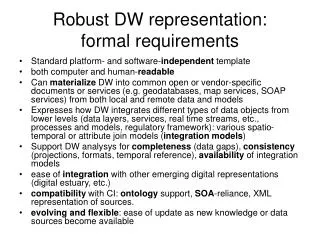
Robust DW representation: formal requirements • Standard platform- and software-independent template • both computer and human-readable • Can materialize DW into common open or vendor-specific documents or services (e.g. geodatabases, map services, SOAP services) from both local and remote data and models • Expresses how DW integrates different types of data objects from lower levels (data layers, services, real time streams, etc., processes and models, regulatory framework): various spatio-temporal or attribute join models (integration models) • Support DW analysys for completeness (data gaps), consistency (projections, formats, temporal reference), availability of integration models • ease of integration with other emerging digital representations (digital estuary, etc.) • compatibility with CI: ontology support, SOA-reliance, XML representation of sources. • evolving and flexible: ease of update as new knowledge or data sources become available
Synthesis models in DW • Co-location in space: boundaries of most data layers are defined by watershed boundaries • Other types: based on functional relationships between watershed parameters (atmospheric, groundwater flows, underlying geology, as well as demographic and economic variables and processes that don’t necessarily coincide with natural boundaries). • For example: pointing to conditions upstream and downstream • DW representation must explicitly include the types of joins between different watershed elements, to make automatic instantiation and update of digital watersheds possible. DW as a system of integrated views.