Download

1 / 9
90 likes | 218 Vues
DNA, or Deoxyribonucleic Acid, is a double-stranded molecule that stores genetic information. It resembles a twisted ladder (double helix), with sugar-phosphate groups forming the sides and nitrogenous bases serving as the rungs. From X-ray analyses by Franklin and the base pairing rules identified by Levene and Chargaff, we know that purines (Adenine and Guanine) pair with pyrimidines (Cytosine and Thymine). Complementary base pairing is crucial for DNA’s stability. The strands run antiparallel, with distinct 5’ and 3’ ends, enabling precise replication and function.

E N D
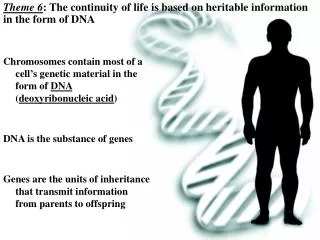
DNA – The Genetic Storehouse • DNA occurs as a double stranded string of nucleotides that are bound together in the shape of a double helix. • If it was unwound it would appear as a ladder, with the sugar-phosphate groups as the two supports and the nitrogen containing base groups as the ladder rungs.
Stucture • From Franklin’s X-ray analysis, we know that there are several repeating sequences that must be accounted for in the structural arrangement. • Levene’s and Chargaff’s work previously identified the structures and pairing rules by the nucleotide bases.
Structure cont. • Adenine and Guanine make up a double ring structure of nucleotides known as the Purines. • Cytosine and Thymine are a single ring nucleotide making up the Pyrimidines. • The chemical configuration of the bases allows for only certain base pairings.
Complementary Base Pairs • Adenine (double ring with 2 H binding sites) can only form a stable association with Thymine (single ring with 2 H sites) • Likewise, Cytosine (single ring, 3 H binding sites) forms a stable relationship with Guanine (double ring, 3 H sites) • These pairings create what is known as Complementary Base Pairs.
The Complementary Bases Two weak Hydrogen Bonds Three Weak Hydrogen Bonds
Complementary not Identical • The two opposite strands of DNA are complementary. They carry complementary base pairs in such a way that the Hydrogen bonding sites line up. • The strands run antiparallel, that is the sugar phosphate backbone point in opposite direction. We call these the 5’ and 3’ ends of the DNA strands.
You are the scientist!!!!!! • Read the Thinking Lab on the bottom of Page 575. Do only the first question.