Value
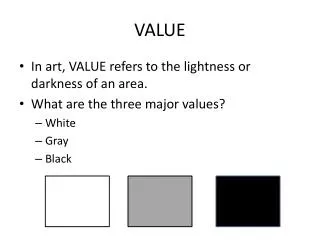
This guide explores the concept of value in art, defined as the lightness and darkness of colors. Variations in value create focal points in paintings and enhance depth through gradation, giving a three-dimensional effect. The principles include tints (adding white), shades (adding black), and tones (adding gray). Value remains crucial, especially in black-and-white artworks, as exemplified by Vincent Van Gogh's "Starry Night Over the Rhone" and Johannes Vermeer's "The Girl with the Pearl Earring."

Value
E N D
Presentation Transcript
Value The Element of Art By: Lily Wang, Angela Kim
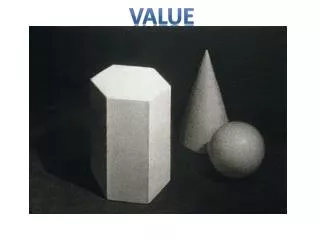
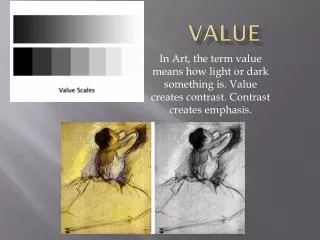
Definition • The word Value means light and dark or shade and highlight used in an artwork • Variations in value are used to create a focal pointfor the design of a painting • Gradationsof value are also used to make the illusion of depth • Light and dark can give a 3Dimpression Marguerite Smith
Details • When you add white to lighten a colour, it is called a tint • When you add black to a colour, the resultant colour is then called a shade • If you add gray to a colour, it results in a tone • Value becomes essential in a black and white artwork Starry Night Over the Rhone Vincent Van Gogh 1888
Examples The Girl with the Pearl Earring Johannes Vermeer 1665