Download
1 / 13
130 likes | 239 Vues
This paper discusses the limitations of existing multicast mechanisms in dense environments, such as stadiums, where video distribution is crucial. It presents simulation results showing that legacy multicast systems struggle due to interference and lack of retransmission mechanisms, leading to significant packet loss. The study explores multicast performance in both single and multiple Basic Service Sets (BSS), revealing that nearly 50% of stations fail to receive more than half of the multicast frames in a multi-BSS scenario. Recommendations for improved multicast techniques are proposed.

E N D
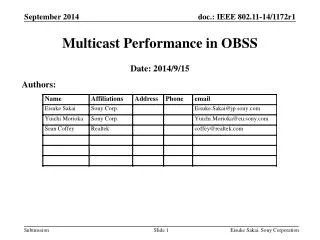
Multicast Performance in OBSS Date: 2014/9/15 Authors: Eisuke Sakai, Sony Corporation
Abstract • Video distribution in dense environment (e.g., stadiums) could be one of the main use cases defined by TGax • Multicast could be the most efficient technique to achieve this use case • Legacy multicast performance in current simulation scenario (14/0980r2) is shown in this submission • More efficient multicast technique might be necessary Eisuke Sakai, Sony Corporation
Multicast Performance in Single BSS • Only 1 BSS in a system • 3Mbps UDP multicast traffic from an AP to 30 STAs • 1Mbps UDP unicast traffic from 10 STAs to the AP Detailed simulation conditions are shown in appendix Eisuke Sakai, Sony Corporation
Simulation Result – Single BSS Legacy multicast degrades due to interferences from itsown BSS since it has no retransmission mechanism Almost all STAs failed to receive 10-20% of multicast frames!! Eisuke Sakai, Sony Corporation
Multicast performance in Multiple BSSs • 19 BSSs in a system • 3Mbps UDP MC traffic from AP to 30 associated STAs per BSS • 1Mbps UDP unicast traffic from 10 STAs to the AP per BSS Detailed simulation conditions are shown in appendix Eisuke Sakai, Sony Corporation
Simulation Results – Multiple BSSs OBSS interferences make multicast performance worse Nearly 50% of STAs failed to receive more than 50% of multicast frames!! Eisuke Sakai, Sony Corporation
Issues with Existing Multicast Mechanism • 11a/n/ac multicast • No retransmission • Offers little reliability since frame collisions often occur in dense environment • No feedback • Cannot control PHY rate in accordance with traffic load or with QoS • Cannot get the best MCS to transmit • 11aa multicast • BAR/BA based retransmission protocol with each STA • Offers very high reliability but need more resources as the number of multicast STAs increases Eisuke Sakai, Sony Corporation
Conclusion • Legacy multicast mechanisms under perform in dense environments • More efficient transmission technique needs to be considered for 11ax Eisuke Sakai, Sony Corporation
Backup Eisuke Sakai, Sony Corporation
Simulation Conditions for multicast performance on 1BSS Eisuke Sakai, Sony Corporation
Simulation Conditions for multicast performance on OBSS Eisuke Sakai, Sony Corporation
Assumed Target PLR for Multicast • Assumptions: • Network Requirement for applications: 1 packet loss in 10 min. • Traffic load = 3Mbps, application payload = 1500byte/packet • Required PLR on Applications : 6.7E-6 • (3 [Mbps] * 600 [s] / (8 [bit/byte] * 1500 [byte])^-1 = 6.7E-6 • Use Reed-Solomon Code for packet error correction to relax the required PLR on wireless system Eisuke Sakai, Sony Corporation
Target PLR on Wireless System for Multicast = 2E -2 When utilizing (B, N) = (30, 5), Target PLR = 2E-2 B :Block length, N: Parity length Code rate = (B-N)/B Required PLR on application Solid line : Code Rate = 5/6 Dashed line : Code Rate = 2/3 Eisuke Sakai, Sony Corporation