Download
1 / 4
40 likes | 156 Vues
This document explores the concept of solubility in water, highlighting the solubility product constant (Ksp) and its significance in chemistry. It provides detailed examples, including the dissociation of calcium fluoride (CaF2) and bismuth sulfide (Bi2S3), along with step-by-step calculations for determining Ksp from known solubility values. Additionally, the solubility of copper(II) iodate is examined, showcasing how Ksp values can be used to find the solubility of ionic compounds in aqueous solutions.

E N D
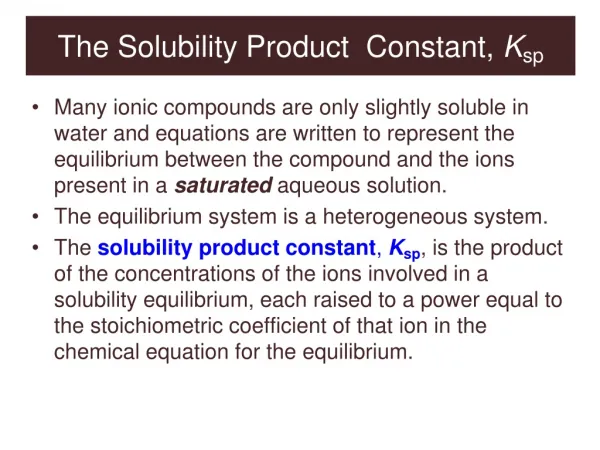
Solubility Product (Ksp) Everything dissolves in water to a point.
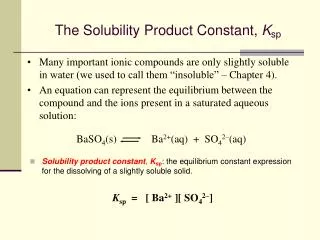
Ksp expressions CaF2 (s) Ksp = [Ca 2+][F -]2 Ksp is really no different than any other K so far. Ca 2+ (aq) + 2 F- (aq)
Calculating Ksp form solubility(M) The solubility of Bi2S3 is 1.0 x 10 -15 M, calculate the Ksp for Bi2S3. Write dissociation equation. Bi2S3 (s) I 1.0 x 10 -15 0 0 C +(2)(1.0 x 10 -15) +(3)(1.0 x 10 -15) E 2.0 x 10 -15 3.0 x 10 -15 Ksp = [Bi3+]2[S2-]3 =1.1 x 10 -73 2 Bi 3+ (aq) + 3 S 2- (aq) =(2.0 x 10 -15 )2(3.0 x 10 -15 )3
Calculating Solubility from Ksp Calculate the solubility of copper (II) iodate from its Ksp value of 1.4 x 10 -7. Cu(IO3)2 (aq) I M 0 0 C +X +2X E X 2X Ksp = [Cu2+][IO3-]2 4X3 = 1.4 x 10 -7 X = 3.3 x 10 -3 M Cu(IO3)2 Cu 2+ (aq) + 2 IO3– (aq) = (X)(2X)2 = 1.4 x 10 -7