Download
1 / 20
200 likes | 322 Vues
This study offers an in-depth analysis of the interaction between extratropical synoptic-scale processes and severe convection, challenging traditional views that these processes merely set the stage for convective activity. Key topics include quasigeostrophic principles, boundary layer influences, static stability, and the role of vertical wind shear and jet streaks. The research highlights how moisture, low static stability, and localized lifting, influenced by mesoscale phenomena, contribute to deep moist convection. The climatological and spatial distributions of convection are also examined, revealing the complexity of severe storm mechanisms.

E N D
Extratropical Synoptic-Scale Processes and Severe Convection Part I Austin Cross Doswell, C.A. III, and L.F. Bosart, 2001: Extratropical synoptic-scale processes and severe convection. Severe Convective Storms, Meteor. Monogr ., 28, no. 50, Amer. Meteor. Soc., 27-69.
Introduction • Traditional view says synoptic-scale processes simply provide setting for severe convection • Instead, using mesoscale processes as intermediary, synoptic-scale view can be taken
Main topics • Overview of QG principles and jet streak processes • Discussion of boundary layer processes and how they relate • Basic climatological distributions of convection
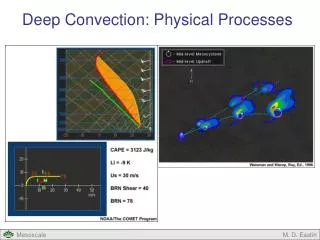
Deep, Moist Convection • Deep, moist convection (DMC) requires three ingredients • Moisture • Low Static Stability • Ascent of parcels to LFC • Extratropical cyclones (ETC) play role in first two, but do not provide enough lift • But they provide environment favoring small scale processes (e.g. drylines, fronts)
Quasigeostrophic • Value is not in prediction, but qualitative understanding of midlatitude, synoptic-scale processes
Static Stability • is assumed to be a function of pressure; actually varies in space and time. • Rising motion favors decrease in stability • Sinking motion increases stability • Emanuel et al (1987) parameterizations, show that ascent is localized and intense, while descent is weaker and widespread • Static stability is important in cyclogenesis and associated frontogenesis
Vertical Wind Shear • Important factor is determining severity of convection • Geostrophic vertical wind shear associated with thermal advection • Strong vertical wind shear is major factor in supercell convection
Vertical Wind Shear • Strong vertical wind shear has been viewed as inhibiting factor for convection, as it tends to reduce intensity of updrafts • Actually promotes new cell development by interaction of existing updrafts and shear • For synoptically-evident, major outbreaks favorable wind shear widespread • But wind shear parameters vary substantially in synoptic scales
Upper Level Jet Streaks • Jet streams have along-flow variation in wind speed that cannot be only curvature effects, called jet streaks
Jet Streaks • Conceptual model used to diagnose ascent areas • Ascent favorable for cyclogenesis and organized DMC • Jet streaks often coupled to low level jet streams, advecting moist, unstable air Figure 2
Planetary Boundary Layer • Defined as the tropospheric layer where the effects of the surface are important • PBL not synoptic because time scale of processes as small as an hour or less • Still interacts with synoptic-scale systems
Diurnal Variations in PBL • On sunny days, PBL has inversion that ascends and weakens • The erosion of the stable layer is one reason why DMC usually begins in afternoon • Movement of well-mixed, dry layer over a cooler layer can create capping inversion, suppressing convection • Capping can promote convection elsewhere by “storing” parcels with high CAPE
Diurnal Variation in PBL • Decoupling of surface and atmosphere creates nocturnal boundary layer wind maximum, especially on sunny days • Diurnal cycle in horizontal temperature gradient, makes for poleward flow increasing with height at night • Combo of both makes low-level jet stream • Diurnal changes in PBL wind profile can modify potential for severe convection
Climatology of DMC • Convection develops when heat redistribution on synoptic-scales insufficient • Convective transport is far less, but more rapid than ETCs • Moisture and instability needed is tied to accumulation of sensible and latent heat in lower levels
Spatial Distribution • Worldwide average is one meter of precipitation annually • Most falls in the tropics • Hsu and Wallace (1976) show that precip • peaks over continents in warm season in mid and low latitudes • follows sun in tropics, except deep tropics and monsoons • While not direct, vast majority of rainfall in tropics, and in warm season extratropically, is from DMCs
Mesoscale Convective Complexes Figure 5 • In Americas, preferentially lee of mountains in mid latitudes, where LLJS common • Elsewhere, mostly in tropics and subtropics • Considerable DMC occurs outside of MCC areas
Great Plains Rainfall • High Plains has notable warm season precip peak • Much of rainfall is from nocturnal DMC • These have two sources: • Afternoon storms from the Rockies • Storms that develop locally with mesoscale weather systems
Global Distribution • Remote sensing (TRMM) shows most DMC over land, except ITCZ • Most likely due to lower heat capacity • Exceptions include surface warm currents along eastern continent boundaries, often associated with synoptic cyclones • Complex terrain also favors DMC even without significant moisture
Temporal Variation • DMC usually is coupled to, but lags, peak solar heating • However, can be tied to synoptic-scale processes, out of phase with heating • LLJS enhanced by nocturnal winds can help convection after sunset • Peak at night over tropical oceans; reasons not understood
Seasonality • Seasonal cycle of DMC follows that of conditional instability • However, DMC are at cores of many explosive maritime cyclones • Occasionally in winter cyclones • In warm sector, similar to warm season • High lapse rates over cold, stable, moist air • Usually only severe weather is heavy precipitation