Exploring Sensory Reception: Eye Anatomy and Nervous System Function in Vertebrates
150 likes | 317 Vues
This lab focuses on understanding sensory reception and the nervous system's role in communication within vertebrates. Students will learn key terminology and identify structures in the vertebrate eye, including photoreceptors—rods and cones—and their functions. The lab emphasizes hands-on practice through sheep eye dissection and various experiments, such as reaction time tests to compare seeing and hearing. Data analysis will be conducted using statistical methods, enhancing skills in hypothesis generation and conclusion drawing.


Exploring Sensory Reception: Eye Anatomy and Nervous System Function in Vertebrates
E N D
Presentation Transcript
Lab Goals: • Know major terminology associated with sensory reception and the nervous system • Identify structures and their functions in the vertebrate eye • Practice science process skills: generating hypotheses and predictions, statistical analysis of data, graphs, and drawing conclusions
TWOPARTS OF THE NERVOUS SYSTEM • Central Nervous System (CNS) • Brain • Spinal Cord • Peripheral Nervous System (PNS) • Sensory receptors • Supporting neurons
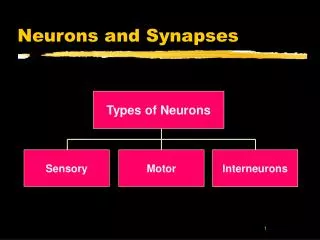
Neurons • Signal travels from cell body down axon • Neurotransmitter is released from synaptic terminal • Received by dendrites of an adjacent neuron • Repeat
Sensory receptors • Mechanoreceptors -Hearing • Photoreceptors -Seeing • Pain receptors • Chemoreceptors • Thermoreceptors
PHOTORECEPTORS • Rods • Vision in dark • Single type • Rhodopsin (Black/white/grey) • Cones • Vision in light • Three types (based on type of opsin) • Red • Green • Blue
Humans Octopus
TODAY’S LAB • T-test • Sheep Eye Dissection (Procedure 1) • Reaction Timer (Procedure 2) • Which is faster seeing or hearing? • Fern spores (pg. 133, 139; camera or draw) • Fungi (procedure on handout) vs. We will derive methods together!
NEXT WEEK • Sensory Reception Lab DUE • 20 pt quiz on Exercise Physiology and Sensory Reception • New TA! Email: Michael.Rodriguez@colorado.edu