Download
1 / 17
170 likes | 324 Vues
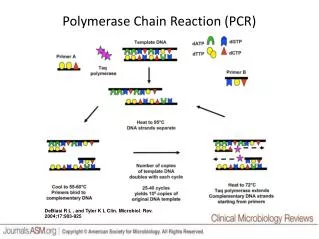
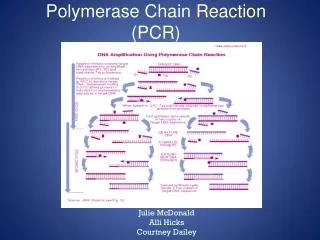
This article explores the fundamentals of Polymerase Chain Reaction (PCR), detailing the roles of primers, including forward and reverse oligonucleotides, in amplifying specific DNA sequences. It explains the importance of annealing temperature (Tm) and its calculation based on nucleotide composition. The article also covers various PCR modifications such as nested PCR and multiplex PCR, as well as methods for analyzing PCR products, including hybridization, sequencing, and RFLP. Additionally, it touches on RT-PCR for quantifying RNA.

E N D
PCRPolymerase Chain Reaction Marie Černá, Markéta Čimburová, Marianna Romžová
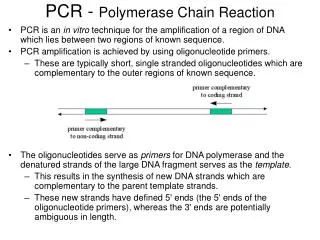
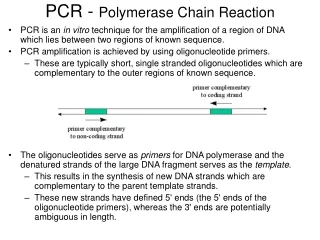
Primers • short oligonucleotides (18 – 30 nucleotides) • forward primer x reverse primer • are complementary to the sequences at the 3´end of corresponding strand, delimited the target DNA region that will be amplified
Annealingtemperature • Tm = [4 x (G+C) + 2 x (A+T)] • Tanneal. = [4 x (G+C) + 2 x (A+T) -5] 5´ GAGACTCAAGAGAACCTA 3´ Tanneal. = ?
Number of copies of wanted DNA region A = 2n n = number of cycles
Modification of PCR • nested PCR • multiplex PCR with sequence specific primers
Analysis of the PCR product PCR with general primers: • Hybridization • Sequencing • RFLP (Restriction Fragment Length Polymorphism) • RT-PCR (quantitative PCR) RNA => cDNA