Understanding Fossils and Geologic Time: Insights into Earth's History
Fossils are preserved impressions in rock that reveal the history of life on Earth, showing when, where, and how organisms lived millions of years ago. They can be formed through various processes, such as petrification, carbonization, and as trace fossils that indicate animal activity. Geologists study the layering of rocks and use relative dating to determine the order of geological events. Radiometric dating techniques further refine these age estimates, allowing scientists to understand Earth's history in detail. The geological time scale categorizes this history into eons, eras, and periods based on the appearance of different life forms.

Understanding Fossils and Geologic Time: Insights into Earth's History
E N D
Presentation Transcript
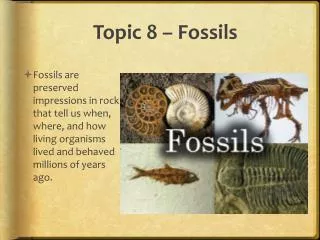
Topic 8 – Fossils • Fossils are preserved impressions in rock that tell us when, where, and how living organisms lived and behaved millions of years ago.
Types of Fossils Remains of dead plants and animals that have been protected from scavengers can become fossilized in a number of ways: • petrified (rock-like) fossils preserve the bones of dead animals by using silica • an outline or impression from the carbon residue on rock surfaces can provide a carbonaceous film
original remains may be preserved in tar, amber or peat bogs • trace fossils are evidence of animal activity, like worm holes, footprints, and burrows • mould and cast fossils are made when an animal dies in mud and gets covered by more sediment. The body dissolves, leaving a mould, which is then filled with more sediment and hardens into rock, making a cast of the original animal.
Topic 9 – Geologic Time • In undisturbed layers of rock, the oldest layers are always on the bottom and the youngest layers are always on the top. • As new layers of sediment form sedimentary rock, the layers can be identified. This layering is called strata
Geologists use a technique called relative dating, to find the order in which events occurred. The relative age of the rock is determined by its position within the strata. • Fossils found in a layer can help to identify the age of the rock. • If the fossil was on the Earth for a short time and widespread then it is called an index fossil.
Clues from Technology • Over billions of years, some elements will change into other elements – uranium is such an element - in 4.5 billion years, half of the uranium will change into lead (which will not change). • This time period is called the half-life of uranium. • By measuring the amounts of change in a sample, scientist can calculate the absolute age of the rock. • This is called Radiometric Dating
Scientists also use a process called radiocarbon dating (which uses carbon-14, a rare form of carbon, as its parent material) • - All organisms take in carbon-14 to build cells and tissue. The carbon-14 changes to nitrogen gas (when the animal dies) in a half-life of 5730 years. The amount of carbon-14 left in the tissue allows scientists to determine the age of the remains
Geological Time Scale • The geological time scale is a division of Earth’s history into smaller units based on the appearances of different life forms. • The largest divisions are called eons, which are divided into eras and then further divided into periods.