Overview
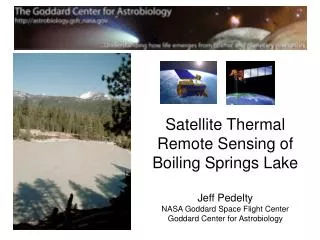
Satellite Thermal Remote Sensing of Boiling Springs Lake Jeff Pedelty NASA Goddard Space Flight Center Goddard Center for Astrobiology. Overview. Work in progress Description of sensors Landsat 7’s ETM+ TERRA’s ASTER Acquisitions of Boiling Springs Lake Temperature determinations & issues

Overview
E N D
Presentation Transcript
Satellite Thermal Remote Sensing of Boiling Springs LakeJeff PedeltyNASA Goddard Space Flight CenterGoddard Center for Astrobiology
Overview • Work in progress • Description of sensors • Landsat 7’s ETM+ • TERRA’s ASTER • Acquisitions of Boiling Springs Lake • Temperature determinations & issues • Future aerial thermal remote sensing ASTER: October 19, 2002
Landsat 7 ETM+ • Landsat 7 launched April 1999 • ETM+ is the Enhanced Thematic Mapper Plus • 16-day repeat cycle • ~15% duty cycle • Conterminous US imaged each overpass • Approximately 10:30AM acquisition • Single thermal band (10.4-12.5) • 60m spatial resolution across 185km area • Data purchased from USGS EROS Data Center ($250 for new acquisitions, $600 < 5/31/2003)
Landsat 7 acquisitions of BSL • Goal was to acquire seasonal sampling at reasonable cost • Scan Line Corrector failure in May 2003 introduced luck into acquisition process • Jan 12, 2005 (gap) • Feb 11, 2004 • May 20, 2005 • August 21, 2004 • August 24, 2005 (gap) • October 12, 2002 (free) True Color Thermal: Feb 2004 Jan 2005
Landsat atmospheric correction • Upwelling thermal emission includes atmospheric contribution and attenuation • Requires local meteorology (e.g. NOAA’s National Center Environmental Prediction) + radiative transfer (MODTRAN) • LTOA = T + Lu + (1 - ) Ld • http://atmcor.gsfc.nasa.gov is a utility to determine , Lu and Ld for each acquisition • Barsi (GSFC), Schott (RIT), Hook/Palluconi (JPL) • Output is land surface temperature (T) • Vicarious calibration campaigns suggest ~1-2K accuracy
ASTER instrument • On EOS TERRA mission (launched 12/99) • Joint US / Japan instrument (JPL) • “Zoom Lens” of TERRA • 15m Vis/NIR, 30m SWIR, 90m Thermal IR • Total of 14 bands, 5 in the thermal infrared • <16 day repeat cycle • 60km swath • Sophisticated multi-band temperature and emissivity retrieval algorithms • Extensive vicarious calibration campaigns
ASTER coverage <100% coverage: but 925,661 Scenes observed as of 9 Feb 2005
ASTER Acquisitions of Lassen Volcano Monitoring Project (http://www.volcano.si.edu/gvp/volcano/index.htm)
ASTER Image Log • Archived data free to NASA researchers (W. Turner approval required, NASA HQ) • 53 Acquisitions from May 2000 - May 2006 • 35 Day • 15 Clear • 18 Cloudy or Hazy • 18 Night • At least 9 Cloudy or Hazy • Trying to obtain image concurrent w/ VFG mtg.
Sample ASTER ImagesOctober 19, 2002 BSL Zoom Bands 321 BSL Zoom Temperature Bands 321 False Color
ASTER Day Temperatures(Removing 2 hazy dates) Temperature Date Within Year
ASTER Day/Night Results Temperature Date Within Year
Issues with ASTER Temperatures • Spillover to ground? • Point spread function is not rectangular • Peak pixel does not measure just lake. • Lower ground temperatures may be bringing down lake temperatures. Perhaps indicated in night data? • Shadowing? • Lower sun angle in winter could result in shadowing of hotter parts of the lake. • Night data indicate this is not a major issue. • Other unknown systematic effects?
Aerial Thermal Remote Sensing • QWIP detector developed at GSFC • Quantum Well Infrared Photoconductor • 1024 x 1024 GaAs array • 4 bands in thermal IR (T and retrieval) • Investigating aerial (or even hillside) data collection at BSL later this summer/fall • Data collection in winter could validate the ASTER/Landsat temperature trends.
Multispectral Thermal Imager (MTI) • DOE technology development mission • Launched ca 2000 • “Point and Shoot” mission, ~10 scenes/day • 20m resolution thermal data (~5m and ~10m) • Highest resolution thermal imaging from space • Operated ~2 years, now in storage on orbit • No acquisitions of Lassen/BSL, but Yellowstone data do exist and I have some in hand. • Perhaps of interest to others
ASTER Imaging Opportunities • ASTER needs to be tasked to take specific images • I have requested an allocation with NASA HQ under the name of NAI ViFoG • See me if ASTER data would be useful for any upcoming field campaigns.